Monday, March 3, 2025

A lady artist in Tenerife


     Very much a Victorian lady, Marianne North was almost certainly one of the best- known British painters, scientists, and explorers who fell for the once unspoilt charms of Spain's Canary Island of Tenerife during the 19th century. 

     A vast number of her paintings of island scenery and plants hang alongside other works of art from exotic and faraway lands inside her own pavilion at Kew Gardens, the Marianne North Gallery, and they are a testament to her love of Tenerife.

Inside the Marianne North Gallery at Kew.
(Courtesy Kew Gardens)

     She was born in Hastings in 1830, the eldest daughter of a prosperous and distinguished family. Her father, Frederick North, was a Justice of the Peace and Liberal M.P. for Hastings, her mother the daughter of Sir John Marjoribanks, 1st Baronet of Lees in the County of Berwick. 

     After originally studying music, specifically as a singer with a fine voice, Marianne turned to painting after her voice failed. She was artistic by nature and lucky enough to be surrounded by several influential friends. 

     Charles Darwin was a principal source of advice and encouragement during her frequent travels overseas. Always interested in plants, she also established an early relationship with Kew Gardens, for whom she collected unusual samples with her father.

Her fearless travels have been a source of inspiration to many writers and illustrators.

     Marianne North began travelling with her father Frederick when she was still very young, and in 1848 accompanied him as far as Vienna, Turkey, Syria and Egypt. But it was only after he died that she truly became a member of that very determined British group of lady travellers and adventurers, visiting Asia, Africa, Australia and America. 

     In Africa she carried out valuable botanical work studying and painting plants and animals. In North America she painted the Niagara Falls and the White Mountains of New Hampshire. In the south she captured some of the most fascinating varieties of exotic plants and animals.

Mount Teide, floating on a nebulous horizon, has always been an inspiring sight.

     It is exactly one hundred and fifty years ago, in 1875, that Marianne North visited Tenerife. Like so many other travellers before her, she may well have been tempted to explore the island by the sight of Mount Teide from out in the Atlantic, or influenced by so many other travellers before her. 

     She headed straight for the Orotava Valley after hearing so much about its stunning beauty. However, she was disappointed to find that so many of the trees and flowers described by naturalists like Baron Friedrich Alexander von Humboldt, in 1799, had been replaced by a Central American cacti variety over the years for the sake of the Canary Island cochineal dye industry. 

Marianne North hard at work.
(Courtesy National Portrait Gallery, London)

     Nevertheless, there was enough to enchant and interest her, and she spent three months painting intensely, illustrating the great variety of colour in the island, often with Mount Teide in the background and palms, cacti, dragon trees and aloes abound in her landscapes.

She captures the north of Tenerife perfectly. 
With a snow-capped Teide Volcano in the distance, euphorbias, cacti and agaves adorn the Tacoronte clifftops.
(Courtesy Kew Gardens)

     She became a guest at Sitio Litre, the house of Mr and Mrs Charles Smith at the time, and many of her paintings capture the amazing variety of flora in the gardens, which are famous and open to the public today. Of roses in these gardens Marianne North is known to have said “I have never smelt roses so sweet as those”. 

One of the most beautiful dragon trees (Dracaena draco) possibly painted at Sitio Litre. Notice the beautiful pumpkins, a common sight in rural areas of Tenerife.
(Courtesy Kew Gardens)

     Marianne North was also a writer, evidencing that her interest in different corners of the globe, and consequently in the island of Tenerife, was not only artistic but also of an anthropological nature. She became charmed by local customs, and by the gentle nature of the inhabitants. 

The two original volumes of "Recollections of a Happy Life".

     Indeed, in her autobiography, “Recollections of a Happy Life”, she emphasises her fondness of Tenerife and its people. She remarked “These people are so friendly and their gardens are marvellous. The ladies flirt with their fans and have flowers in their hair. They behave in a very ladylike manner although they possess no more education than that received in some convent”.

     At heart she was most interested in the preservation of nature, of course, so I do wonder what she would think if she were to spend a holiday in the Canary Islands today. Perhaps, if Marianne North were still alive, some politicians might consider her a radical ecologist! 

     We might presume that as long ago as the 1870s the natural treasures of Tenerife would still have been relatively undisturbed by human progress. Nevertheless, Marianne North lamented, even then, “It is sad to see how civilised people can destroy natural treasures in such a short period of time, when neither animal nor savage has ever done any harm in centuries”.  

By John Reid Young, author and Canary Island tour guide.

Books by John include:

The Skipping Verger and Other Tales, a collection of short stories.

A Shark in the Bath and Other Stories, a collection of short stories.

El Hombre de La Guancha y Otras Historias, a collection of short stories.

The Journalist, a novel.

For more information, or if you would like to read any of my books, please click on the images to the right of this page.

Please sign up for an occasional newsletter here: https://mailchi.mp/249fadd56fdd/author-john-reid-young

Facebook: https://www.facebook.com/theskippingverger

Twitter: @reidten

Instagram: authorjohnreidyoung

#artist #travel #art #history

Saturday, February 1, 2025

CARNIVAL


The first carnival parade in Puerto de la Cruz

          There were six magnificent chariots, invented with exquisite imagination. There were groups playing percussion instruments and singing Canary Island folk songs. There were ladies and gentlemen dressed like seventeenth century aristocrats, mounted on a brigade of horses. They all sailed passively along the dusty lanes and into the cobbled streets of the old port. It was the beginnings of what was to become a tradition and it happened just over a century ago.
 
          It was February 1910, in fact, and almost every inhabitant in what was then a busy trading port watched in amazement and delight as a brilliant spectacle of two thousand participants from all over the Orotava valley took part in what was the first ever carnival parade to be held in Puerto de la Cruz. It was the birth of what has become a famous, colourful, noisy, joyous, popular, carnival festival.
 
          Most of those who led the parade were members of wealthy families in the Orotava Valley.  A good number were from the British and other foreign communities. The initiative came from the recently constituted Tourism Committee and the owner of a local newspaper called Arautápala, a well-travelled gentleman who had witnessed a similar event at Nice on the French Riviera.

          The six chariots, one of which was designed by local artist and photographer, Marcos Baeza, comprised one of Columbus’s ships, a Viking longboat manned by members of the British community, a Zeppelin airship with an elegant crew of German residents, a Swiss country scene, a tray of fruit and vegetables and another one depicting a colourful basket of island flowers.

  The Viking longboat manned by British residents in 1910
(note the Martianez cliffs behind)

          The chariots representing ships almost certainly stemmed from original Roman traditions. Whether modern carnival revellers wish to believe it or not, the word carnival may not only have its origins in the Latin carnem levare, the abandoning of meat for Lent. 
          Instead, carnivals may owe their origins much more to the satirical parades in ancient Rome when Bacchus, the God of Wine, permitted disguises to hide immoral public exhibition, when the God’s personal priest led the parade on a ship mounted upon wheels. His vessel was called the carrus navalis, the naval chariot. 
          Others suggest the word carnival actually derives from another Roman festival, navigium isidis to honour Goddess Isis, navigium being th Latin for ship. 

The Navigium Isidis procession in Rome
(by American orientalist artist Frederick Arthus Bridgman in 1902)

          Of course the devotion of man to wearing disguises possibly originates in ancient Egypt, Greece or even Japan. But it was the flamboyant and inventive Venetian Italians who introduced masks to hide faces, not just as a source of amusement but also to avoid recognition and punishment whilst committing a vengeful crime, participating in a conspiracy or being carnally unfaithful.  
 
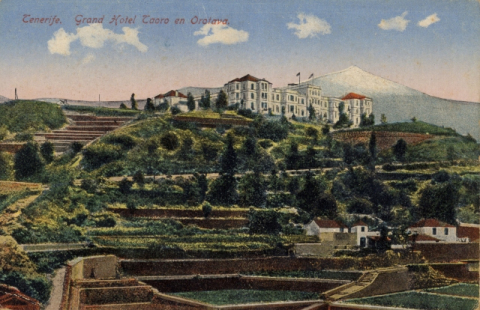
          The parade in 1910 took the British Vikings, the German Zeppelin, the Spanish caravel and the rest of the magnificent procession along the Calle Valois, up the hill as far as the magnificent Taoro Hotel and then down again to the main square in the heart of the town. 

The Grand Taoro Hotel with the snow-capped Mt Teide behind

          Not one of these foreign residents and friends could possibly have imagined that just four years later they would be cruelly battling against one another from other kinds of grey, armoured vessels in a bloody war. Yet, it was there at the Plaza del Charco square where a great battle took place as participants and onlookers had the most tremendous fun bombarding each other with flowers and petals. This too became a tradition. The party didn’t end there. 
          Although the Spanish Civil War and its hungry aftermath dampened such celebrations, and carnivals were virtually forbidden during the earlier years of the Franco dictatorship, the splendid ball at the Taoro Hotel on the eve of the carnival parade became a yearly event. This dance actually took over from private functions because, prior to that first carnival parade of 1910, wealthy families in Tenerife, as they would do in Spain and France, had traditionally celebrated fancy dress dances in their own grand houses. 
          It was only after the Orotava Valley began to attract the first foreign, and especially British travellers, towards the end of the 19th century, that businessmen realised an annual public carnival would help bring a new form of lucrative tourism to Puerto de la Cruz. Indeed it did, and if we can learn from history and the elegance of the old ways, perhaps Puerto’s carnival could once more help the town revive its once booming tourism industry.

 
By John Reid Young, author and Canary Island tour guide.
Books by John include:
The Skipping Verger and Other Tales, a collection of short stories.
A Shark in the Bath and Other Stories, a collection of short stories.
El Hombre de La Guancha y Otras Historias, a collection of short stories.
The Journalist, a novel.

For more information, or if you would like to read any of my books, please click on the images to the right of this page.

Please sign up for an occasional newsletter here: https://mailchi.mp/249fadd56fdd/author-john-reid-young

Facebook: https://www.facebook.com/theskippingverger

Twitter: @reidten

Instagram: authorjohnreidyoung


Thursday, September 14, 2023

On the way to the cemetery


When I was a boy, just the other day, life in the Canary Islands was still comparatively primitive.

While Puerto de la Cruz, on the island of Tenerife, was beginning to take shape as a package holiday resort at the end of the 1950s, there were still two main classes of inhabitant, the rich and the poor, the landowner and the peasant. In between, there were the sharecroppers and the fishermen.


The banana plantations between the old Martiánez Hotel and the beach had been cleared 

There was vast private wealth in land, and in many rural areas inhabitants lived a very simple kind of life, serving the sometimes feudal landowner and sharing the crops the land produced. They were the poor. This was until General Franco’s regime began implementing the Limited Rent Housing Law of 1954 and the Urban Leases Law of 1964, a social housing plan which saw the building of over four million affordable houses for the poorer classes throughout Spain, including the Canary Islands. Most owners managed to pay them off within ten years. As a result, many of the peasants’ traditional stone cottages dotted around the landscape were abandoned for the comfortable state-built housing estates. It also saw many peasants abandon thousands of agricultural terraces for more prosperous wages in town.


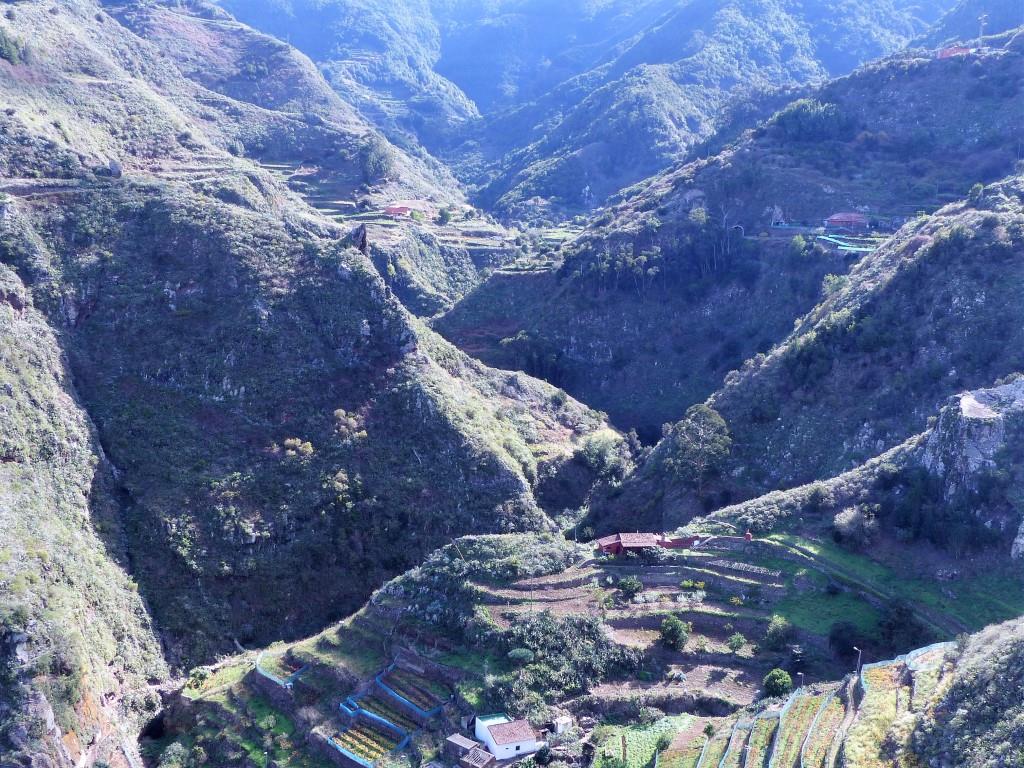
Some of those abandoned terraces, like these in the El Río gorge, are being recovered

I grew up in the 1960s and my father once owned a finca in the hills above Tacoronte. I still have vivid memories of half-naked children hanging onto the skirts of bare-footed mothers who peeped out of the wooden doorways of stone cottages beside the lanes that led to the farm. They would stare and wave at us as my father drove the Land Rover up the muddy tracks to our farm. The kids learnt to beg for half a peseta, or to barter in exchange for a handful of plums, chestnuts or blackberries. 

My father employed mostly women on the farm, and it was always a joy to hear their singing and laughter as they worked. He built the farm manager a proper house, while he prefered us to sleep in a rather dodgy wooden hut which was erected on a concrete base under the pines and above the plum orchard.


Grandmothers often came to give good advice or to keep an eye on the children

Country folk rarely travelled far, and many were born and died without ever visiting the nearest town, like one or two centenarians I have met in remoter hamlets of the Anaga mountains. They were and remain extremely generous and helpful to each other as communities. The farming chores, like gathering in the wheat and threshing it on the eras, filling the sacks with grain and carrying them on their backs or on mule to the Tacoronte market, were happily shared. 


This very old era, or threshing ground, can be found near Teno Alto

When somebody died, however, the world came to a halt. Neighbours would gather outside the family cottage to pay their respects, and to accompany them during the ritual wake. They would often take food for the grieving family because a cooking fire was not lit for a day or two in respect for the departed. Then, when the priest sent a signal, men would sway in solemn procession down the lanes to the nearest church or cemetery. By law, the dead would need to be buried within forty eight hours after death.

In Lanzarote there is a little village called Soo. It nestles between the Colorado Peak, the highest point of one particular volcanic cone, and what was often referred to as the Soo desert, a grain of sand compared to the neighbouring Sahara.


The pretty village of Soo, as it is today

Not so long ago, when a member of the family passed away, grieving women in Soo would lock themselves into the dead person’s home for eight days. The custom, which only disappeared in the middle of the 20th century, was so that the neighbours could care for and feed the grieving family during those days of mourning. The men, I understand, were excused. They would be required to attend to the animals and the crops. Many years ago, it used to be the custom in all the islands that women never went to funerals. They would only be expected to attend a memorial mass on the third day after a death.

Unlike today, when visiting doctors are often seen in remote villages checking up on the elderly, there were still no doctors or caretakers to cater for peasants well into the 20th century. Country folk either never became ill or, if they did, cared for each other with ancient herbal remedies. If sickness or old age ended in death, men carried their own dead on their shoulders to the cemetery. They would not be taken in a coffin but laid on a simple stretcher made with sticks. It actually made sense because it was a much lighter mode of transportation, and they would often be required to walk considerable distances to a final resting place in holy ground.


A doctor visits elderly people in their Chinamada cave dwellings once a week

More than one story has been handed down from generation to generation telling of porters suddenly being given the fright of their lives on their way down from the hills to the cemetery. Pancho, who owned a pottery kiln above Arico, a village on the south eastern slopes of Tenerife, was a recognised tile maker. He died just before the Spanish Civil War, after apparently collapsing during an argument at the village inn.

His body was lovingly bathed and proudly dressed in his best clothes. But, on the way to the cemetery, transported by men in solemn procession, his rigid body suddenly sat bolt upright on the stretcher and it shouted out, “Hey, what the Devil is going on?”

The stretcher bearers immediately dropped their dead baggage with a hard bump on the ground. They, and the body's relatives and neighbours, scattered, terrified in all directions. Well, with no proper doctor at hand to certify a death, a corpse might at times only have given the impression of being a corpse. Pancho survived to have another argument at the village inn.


A street in the old town centre of Arico

They were definitely more civilized on the island of Lanzarote. They often used camels to rock the dead to the cemetery. Nevertheless, the road to the burial site could be long and hot, with hardly a drop of water to be found. So, if the procession happened to pass close to a village where there was a fiesta going on, the mourners wouldn't hesitate. They would simply join in the festivities, refresh themselves with some good wine to accompany a bowl of goat meat stew and then continue solemnly to the cemetery.

In the village of Teno, situated in the mountain range to the extreme west of Tenerife, the small number of inhabitants who dedicated their lives to sheep, goat and arable farming, were believed to use a specially prepared stretcher for carrying their dead. In fact, unlike the disposable stretchers made with sticks, it was a long box, like the crude wooden ones seen in cowboy films. It had wooden poles attached to each end and was designed to be transported by just two men. The narrow, rocky path down the mountainside was too narrow and dangerous for more than a single file of men to walk down. Then, when the procession reached the Bujame or Negro gorges, the dead person would be transferred into a proper coffin for the rest of the journey to the cemetery which was situated at the coastal town of Buenavista. This mode of transport was still in use as recently as the 1970s because, until then, there was no road to Teno. Like the village of Masca, the hamlet was pretty well isolated from the rest of the world.


Negotiating the mountain tracks into the Bujame gorge could be tricky

As at almost every funeral, processions on the way to the cemetery attracted quite a crowd. Every adult male member of a village would take part. Milking the goats, preparing the terraces or digging the potatoes could wait until tomorrow. The respect paid to the dead and to the grieving family was sacred. It was, and still is, in the nature of these wonderful islanders, and one can still feel the strength of unity today in those rural communities.   

By John Reid Young

Author of:

The Skipping Verger and other Tales (a collection of short stories)

A Shark in the Bath and other Stories (a collection of short stories)

The Journalist (a novel)

For more information, or if you would like to read any of my books, please click on the images to the right of this page.

Please sign up for an occasional newsletter here: https://mailchi.mp/249fadd56fdd/author-john-reid-young

Facebook: https://www.facebook.com/theskippingverger

Twitter: @reidten

Instagram: authorjohnreidyoung


Friday, November 19, 2021

When Tourists saddled up to the call of a volcano in Tenerife.


    In recent weeks, since the eruption from the La Cumbre Vieja mountain range began on 19th September, on Spain's Canary Island of La Palma, scientists have been learning and exchanging more information about Strombolian eruptions than ever before. However, even they understand that against the forces of nature, especially those deep in the Earth's bowels, mankind has not got a chance.

A beautiful sunset, with Mt Teide above the clouds. To the right, a dramatic plume speaks of La Palma's eruption. 
(Photo taken during a picnic on 21.09.2021). 

     What began as a sparkling and exciting event, with magma and gases creeping through volcanic tubes and pushing their way to the surface, like a kettle coming to the boil, soon turned into a nightmare, and devastation for inhabitants of La Palma. 

     Hundreds of homes have been buried under rivers of lava, swallowing up the memories of generations and turning some of the finest banana plantations into petrified, fuming rock, whilst treasured black-sand beaches have been smothered by smoldering lava. Inhabitants are also suffering the consequences of the fallout, in the form of ash particles weighing down roofs and blanketing everything with something resembling powdered, black snow. Sulphur dioxide has poluted the air they breathe. COVID pandemic rules imply the compulsory wearing of masks. Now people wear masks to protect their health, not from a man-spread virus, but from the dangerous levels of volcanic debris and chemicals in the air. 

Like a snake, a river of magma finds its way in La Palma

     The island of La Palma, la isla bonita, is over 50 miles away but we, on the island of Tenerife, have memories of our own volcanoes, of course. One only has to visit the great Las Cañadas caldera to realise that Mount Teide Volcano is just a small hillock compared to what may have been there long before. We also have written memories of the last eruption on the island, a little over 100 years ago. Not only memories, but a feeling, not so deep down, that anything might happen one day. After all, as La Palma has come to remind us, the Canary Islands are still volcanically active.

     On rare occasions we have felt the minor Earth tremors that have been keeping people awake on La Palma. Some of us remember, only a few years ago, before the under-sea eruption off the island of El Hierro in 2011, that there were whispers about an imminent eruption on Tenerife. A series of earth tremors, centred between the towns of  Santiago del Teide and Icod, got people all het up. Even a few English newspapers told their readers that Teide was about to blow its top! A maximum register of 3.2 on the Richter Scale was not much to worry about, but the coincidence of a number of similar shakes over a period of weeks persuaded the authorities and scientists to come clean about the fact that something might have been about to happen. 

     Although nothing actually did occur at the time, local gossip also led to similar conclusions. Tomás, the lovely old gentleman from La Guancha who used to come with his lorry on Saturdays to sell us home-grown fruit and vegetables, told us there was a cave to the south of Icod from which nasty smelling gases had begun to appear. Mind you he was also convinced that the unusually hot weather we had been having at the time was also due to volcanic activity!

     The authorities tried to persuade public opinion that if anything did happen, it would not be on a catastrophic scale. Indeed they believed, if it happened at all, that it would be “a gentle, Strombolian eruption” which might perhaps start a few forest fires and burn a house or two, but no more. Scientists supported that belief. However, as La Palma has evidenced now, nobody can predict nor control the damage an eruption might cause, or where exactly a volcano might decide to appear in its explosive beginnings. Having said that, scientists, using modern equipment and satellite images, were almost exact in pinpointing where the Earth would give this time.

The "gentle eruption" of Chinyero (Tenerife, 1909)

     Perhaps memories of the last eruption on the island of Tenerife, in 1909, had persuaded people that any eruption would be "gentle", until this new La Palma volcano. 

     Nevertheless, when Chinyero erupted, the municipality of the Valley of Santiago was practically cut off from the rest of the world. Messenger pigeons became the essential means of communication during the eruption. The information carried by the birds took no more than 5 minutes to reach Garachico from Santiago del Teide. From there, the news was then urgently transmitted to the authorities by telegram.

     The eruption of Chinyero, however minor, produced a whole range of reactions. Fearful inhabitants took their religious images up to the lava flows and legend suggests the lava came to a halt where they stood. Victorian tourism found ways to take advantage of the situation and a number of excursions were organised to visit the volcano. Moreover, the Chinyero is famous for having been the first volcano to have been mentioned in the press, and to have been filmed and photographed. It is also the first to have been studied by contemporary scientists and about which extensive, scientific reports were made.

     Chinyero began to erupt just after two o'clock in the afternoon of 18th November, 1909. Its activity lasted for 10 days, unlike the new La Palma eruption which, as I write, is two months old and still going strong. The eruption was preceded by a series of earth tremors and underground noises which alerted the inhabitants in Santiago del Teide and neighbouring regions. The eruptive process began when a 600 metre long crevice opened up and this was accompanied by loud explosions, heard as far away as La Laguna and Santa Cruz. The eruptive column towered sky high. As one local resident described,

“It gave a great thundering sound and the plants and trees flew into the air with the smoke and earth. The shrubs went up, turning over and over and were covered in black and red earth. Huge stones were also flung out, everything spreading out when it reached high up, and bits of gravel came down on us, so hot that we could not hold them in our hands.”

      There are also memorable tales about folk in the Orotava Valley. Some were brave enough to take a close look at the eruption. I remember being told by Noel Reid that he witnessed the eruption at close range. He was a lad of seventeen at the time and remembered that there had been a series of earth tremors for a couple of months before the eruption. 

     The first sign that the earth was attempting to breathe was when news arrived that gases had appeared from a cavity on the side of Mount Teide. Everyone thought the peak itself would erupt and foreign residents hastily began to pack their bags. Many British residents took boxes and cases for safe-keeping at Casa Reid in Puerto de la Cruz or at El Nido, the Vice Consul, Tom Reid’s home, itself built in 1894 on the top of a volcanic rock. Some residents were invited to stay, resting wherever they could find space, indoors or on the verandas. 

El Nido, the British Vice-Consul's house in the Orotava Valley.

     From other parts of the island, the noise of the explosions from the eruption could be heard like distant thunder, and the amazing red glow of lava shooting into the sky were very spectacular. Local people were frightened. The Bishop of La Laguna ordered everyone to pray. But the rumblings and the glow seemed to go on for days without apparently causing great harm. 

Tourists from around the island got a close look at the volcanic eruption (1909)

     Therefore, like a number of others, Noel Reid and a group of mostly Spanish friends, including Anita Perez, a beautiful local girl who lived at a house called Los Frailes, could no longer resist the temptation. They decided to get a closer look and rode their horses as far as Icod de los Vinos, and up into the hills along the old carriage track.

They rode into the hills from Icod de los Vinos

     They left their horses at a certain distance, for fear the animals would become nervous as they neared the constant explosions, and walked higher into the hills where they set up camp close to the inhospitable black, old lava flow produced by another volcano, the Trevejos, which destroyed part of the original trading port of Garachico in 1706. 

The Trevejos Volcano erupting and destroying part of Garachico, as depicted by artist Ubaldo Bordanova

     The following day, the intrepid group of adventures then proceeded on foot to within half a mile of Chinyero, to see the earth flinging rocks high in the air and spewing lava. Noel Reid, who just seven years later was much closer to hell, earning the DSO for bravery at Ypres in the First World War, and his party of youngsters, were not the only ones to get a close look at Chinyero. 

Captain Noel Spence Reid DSO, MC (born in Tenerife in 1892)

     Another member of the distinguished British community, Austin Baillon, often recalled his own father, Alex Baillon’s memories. According to him, the thunderous explosions could be heard from as far as the island of Gran Canaria. People in nearby villages, like Guía de Isora, spent the best part of a week in the streets. Seven craters opened up on a plain. Liquid stone was blasted 600 feet into the sky and glowing lava gushed into the night in four huge, slow-moving rivers, like immense burning snakes. Alex Baillon said it was a splendid sight to see the frightful force of nature. 

     There is a tale about the priest of Tamaimo holding continuous prayers in the little chapel, begging for the lava not to reach them. It stopped just before the village. 

     Until the current eruption of La Palma, it was hoped, and almost believed, that any future eruption would be as safe and as obedient to Christian prayer as Chinyero, or perhaps no worse than Chahorra, the fissure eruption that appeared on the side of Pico Viejo, alongside Mount Teide in 1798. 

     One can only pray, in fact, judging by what we have witnessed these days on La Palma. Prayer, even for the non-believer, is all we have when nature decides the pressure has become too much. 


BY JOHN REID YOUNG

Author of books:

THE SKIPPING VERGER AND OTHER TALES, 

A SHARK IN THE BATH AND OTHER STORIES, 

EL HOMBRE DE LA GUANCHA Y OTRAS HISTORIAS, 

collections of short stories set in the Canary Islands,

THE JOURNALIST, a novel. 

(For more information, please click on the images to the right of this page).

Owner of TENERIFE PRIVATE TOURS http://tenerifeprivatetours.com/

If you would like to receive news about my next publications please sign up for my newsletter here: https://mailchi.mp/249fadd56fdd/author-john-reid-young

Facebook https://www.facebook.com/theskippingverger

Twitter: @reidten

Instagram: authorjohnreidyoung


Friday, April 24, 2020

A Very British Kind of Place on the Canary Island of Tenerife


          They were very different times. The number of inhabitants in Puerto de la Cruz on the island of Tenerife may not have been much more than five thousand. A fair number of those were British and Irish. Early forms of tourism were just beginning and town houses were being converted into pensions and boarding houses to cater for the growing number of travellers, scientists and artists. So quaint, if we compare it to the five star luxury hotels in today's modern resorts, the beautiful old Martianez Hotel offered improved sanitary arrangements installed by an English plumber. One could stay at the Marquesa for seven pesetas a day. There were no roads but dusty tracks and caminos reales, stone highways connecting the old port with the towns of La Orotava, Los Realejos and beyond. A carriage from the port to La Orotava cost as much as ten pesetas. Visitors could hire a landau for 600 pesetas a month or a donkey for two and a half pesetas for a morning. There was the beginnings of an electricity supply, generated by water flowing from a water gallery at a point near Aguamansa and supplied to only a few wealthy properties. There was no television. There was no rush.

The Martianez Hotel in Puerto de la Cruz

          The small and distinguished community from the British Isles and the growing number of winter visitors were regarded with respect and affection and went about their business with gentility. Nevertheless, although they were a very cultured lot and therefore needed little in the way of entertainment, because they made their own, they lacked a very important ingredient. There was nowhere, outside the privacy of their own home or boarding house, at which to enjoy a decent game of one kind or another.

          So one should not surprised to hear that in 1896 a small group of those intrepid pioneers hired rooms above a chemist owned by a gentleman by the name of Ramón Gómez, in Calle Santo Domingo, a street just above the fishing harbour. It was there that they founded a games club called The Guanche English Club. They had a billiards table and a cardroom, and drinks were served. To them it might have seemed like the beginnings of their very own version of the Travellers or Caledonian clubs in London, to which gentlemen could slip away to escape a female plot. But that wasn't the case at all. Ladies, as in so many British colonies, were very much a part of the act and the club was a regular host to the Orotava English Musical and Dramatic Society, an early equivalent to today's English Speaking Theatrical Association in Tenerife, better known as E.S.T.A.

Puerto de la Cruz with ships at anchor


          What they really yearned for was some outdoor activity, a bit of sport, old bean! Therefore, in October 1902, at about the same time Kitchener was putting an end to the Boer War, the beginnings of an outdoor games club began to blossom in the Orotava Valley, although there had already been attempts to get a golf links going outside the valley, at La Quinta in Santa Úrsula. 

          Captain Hamilton Boyle, Reverend Humphreys, Doctor Lisham and Messrs Woolley and Osbert Ward, author of The Vale of Orotava, a guide-book published in 1903, decided it was time. They met for an afternoon of outdoor activities at San Antonio, where Walter Long Boreham, one of the main benefactors of All Saints church had lived, because there was what they called a cement lawn-tennis court as well as a small croquet lawn. 

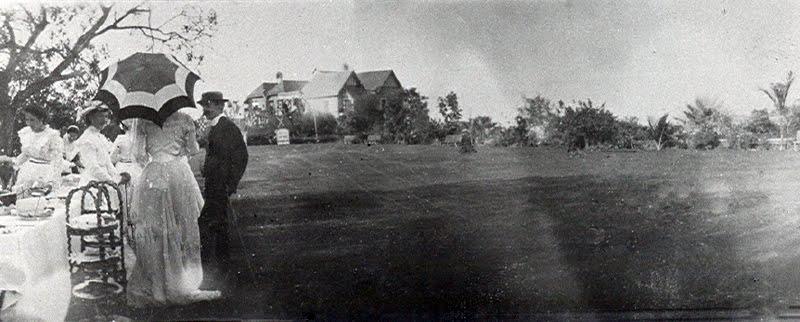
          The same group agreed to meet again, this time with Vice-Consul Tom Reid and Mr Gregory at El Robado, Colonel Owen Peel Wethered’s magnificent mansion at the heart of what today we know as San Fernando. El Robado's gardens, which were described as spacious and where croquet and the ancient game of bowls could be carried on in a most scientific manner during picnics and tea parties, would be an ideal venue.

A tea party at El Robado

          Four years later the popularity of these games parties at private houses, and the growing number of visitors to Puerto de la Cruz persuaded these fun-loving British residents to rent the grounds adjacent to San Antonio from doña Celia Zamora in order to establish a permanent club. A huge sum of seven hundred and fifty pesetas a year was the agreed rent. 
          
          The new club, the Orotava Bowling and Recreation Club was declared open on 15th November, 1906. Subscriptions were set at thirty pesetas a year, twelve and a half for three months and five pesetas for just one week. Steamers, like the Avocet or the Ardeola which belonged to the Yeoward Brother’s Line and could be seen at anchor off Puerto de la Cruz while they loaded bananas, were bringing a constant flow of winter visitors to the club. It was becoming a tremendous success and in 1908 the club was registered for the first time under Spanish law as an association. 

The original bowling green at the club

          Those who preferred bowls were indignant in 1907 when upstarts asked if they might play tennis on their tender bowling green. The request concentrated minds on the fact that proper tennis courts would have to be on the agenda. Alas, they would have to wait because war got in the way. Indeed, suddenly, it all changed. The rumblings of the Great War began to affect the arrival of merchant and passenger shipping to the Canary Islands as German U-Boats took their toll. Few new visitors made the journey and younger club members volunteered to fight for King and country. Life and membership at the games club was badly affected. 

          It wasn't until 1924 that new tennis courts were laid just where they are today, albeit overgrown with weeds since the British Club was asked to leave the premises. Tennis almost became the main event and matches began to be organised against rival clubs such as the Hesperides Club of La Laguna and The British Club of Santa Cruz. Faces grew younger in between the wars and as the 1920s swung in so did the demand for a bit of harmless fun, and dances and other activities were organised in style.


The tennis courts at the British Club (note the long whites)

          The club also survived the Spanish Civil War and, immediately afterwards, WW2. It kept going thanks to that old, solid British spirit, keep calm and and carry on. It was also thanks to its Spanish members like the Marquesa de Villafuerte, the Llarenas and the Salazars that the club actually carried on playing games.

The Club rules were even translated into Spanish

          Indeed, the club bonded great and lasting friendships between families like the Machados and British residents. How they loved their croquet, especially when the game was played on the large green beside the clubhouse. Bowls always seemed just a bit too English for them, with all that bending down on one's knee and those memories of Sir Francis Drake and the Armada. 


Tom Reid (British Vice-Consul) and Noel Reid (First Junior Member, aged 16) pictured on the croquet lawn in 1908

How they loved their croquet!

          Especially after WW2, the club boasted some of the best young tennis players in Tenerife, like Alfonso and Antonio Cologan, of Irish ancestry, and their brother Leopoldo, Marqués de la Candia. They were good years when members like Felipe Machado, who purchased Risco de Oro from George Marriott, was Vice-President and Leopoldo Cólogan were on the committee under Noel Reid who had carried on with the work of his brother Rio.

          In between and after the wars the club had prospered. It became an open and friendly place, and consequently more and more cosmopolitan, with a number of very distinguished and able European members and quite a few American and Canadian representatives always willing to lend a hand. Nevertheless it retained a very British feel about it. Her Majesty´s birthday was celebrated as loyally as in old British dominions and colonies. Officers from visiting Royal Navy ships were graciously entertained by the club for many years and their ship's crests were proudly on display around the bar. A smoky, ruthless game of bridge could be fought in a quiet corner of what was the Dick Peto room, named after a member who donated a thousand pounds, a huge sum in those days, after WW2.

Some club members celebrating Armistice Day in 1929
Antonio, the gardener, is on the left
If anyone would like to know who the others were, I'd be happy to tell you.

          A splendid, strategic and sometimes uproarious bowls competition would entertain a critical audience, before and after a gin and tonic. A serious game of tennis could be had any day, provided one fetched one's own stray ball from the banana plantation. In the latter years of the 20th century bandits fought against angels in thrilling and hilarious Sunday tournaments. A gentle tea and biscuits, served by Rosa and duty lady members, were available to ease one out of an afternoon siesta. Charitable dinners, competitions and seasonal dances were arranged and held in grand and traditional style. The bar was a regular meeting place for many a resident who simply wanted to relax, chat and enjoy a drink at a very reasonable price and in very pleasant surroundings.

The original entrance to the British Games Club.

          It would need a book to fully account for the history and traditions of what is still today known as the British Games Club. Even though the club was forced to move, and did so in style and with that same keep calm and carry on attitude, to Club de Tenis Puerto de la Cruz, sometimes better know as Alvaro's Club, a careful study of many of its members, past and present, would certainly reveal a wealth of talent, culture and experience. The club, just as the other pillars of the British community, the English Library and All Saints Church, reflect a unique British volunteering spirit. Silently, behind the scenes, there will always be those prepared to work tirelessly in the interests of their British community.

Alvaro's Club

          When the current crisis is over, the COVID-19 storm, anyone joining the club will realise at once that present members maintain the old club’s high standards. Newcomers will soon feel glad to be a part of its delightful character, especially with all its lively activities. There have been changes, of course. Apparently, in 1955, when new, young and radical members suggested that cold drinks, including beer, might be served after games, many of the senior members got into a flap. Hip flasks would be permitted, of course, what, what!

By John Reid Young


(This is an adaptation of a previous article of mine, published fifteen years ago in island newspapers, and certain images may have been reproduced from internet with no personal financial gain intended.)

Author of books "A SHARK IN THE BATH AND OTHER STORIES" and "THE SKIPPING VERGER AND OTHER TALES", collections of short stories set in Tenerife and the Canary Islands". (For more information click on the images to the right of this page).

Owner of Tenerife Private Tours....http://tenerifeprivatetours.com/

If you would like to receive news about my next publications please sign up for my newsletter here: https://mailchi.mp/249fadd56fdd/author-john-reid-young