Tuesday, February 24, 2015

Harold Lee, an Englishman in Tenerife

Like many other travel authors of his time Harold Lee placed the Portuguese Madeira archipelago and the Canary Islands into one area of study. Both groups of Atlantic islands form part of Macaronesia, the Islands of the Fortunate or μακάρων νῆσοι makárōn nêsoi, as ancient Greek geographers referred to them. But there was another, more practical explanation for this. Steamers from the British Isles carrying passengers to the colonies often called in on both. His book, Madeira and the Canary Islands, a Handbook for Tourists which was published in Liverpool in 1888, is a constant comparison between the two and he portrays them, especially the island of Tenerife, with charm and candour.   

Madeira and the Canary Islands, published in Liverpool in 1888
The image of Mount Teide, of course, captured his imagination from the moment it became visible from about ninety miles away and, as so many adventurers and sailors long before him, he paid reverential attention to the great volcano. With a wicked sense of humour that on occasions betrayed a very Victorian and superior attitude towards the rest of the world he wrote of passengers on board the ship en route from Madeira to Tenerife virtually keeping themselves awake in order to be the first to spot the peak. Nevertheless Lee, whilst perhaps not so elaborate as some writers when he described Mount Teide, was both lyrical and accurate when he suggested, 

You must not look at the horizon itself, but in the sky above. Then, as you gaze, you will suddenly behold it, not looking like land at all, but to all appearance a nebulous cone, faint sepia in tint, floating above a deep bank of haze or cloud.

Mount Teide, as seen from afar, floating above the clouds
Most visitors in the late 19th century aimed to stay in the Orotava valley which indeed charmed him and where oleander, euphorbia, poinsettia and hybiscus flaunt their radiant colours before every passer-by and where orange trees were borne down to the earth by the sheer weight of their golden fruit. But Lee preferred the gentle rhythm of life in the capital, Santa Cruz, possibly because he liked to study people and their ways of life, especially those which so differed from his own. 

Santa Cruz, a place of extraordinary beauty, according to Harold Lee 

He paid tribute to Camacho's, Clarke's and The International hotels. These, as one can imagine, were splendid and delightful examples of a different age. Camacho himself is a Portuguese who speaks English and understands English ways. How very, very superior indeed! The Camacho was advertised as an English Hotel, the oldest, best and most centrally situated, having forty large well-ventilated bedrooms, with sitting room, billiards and smoking rooms. Furthermore, there was even a bathroom on each floor and sanitary arrangements were examined by a Doctor Paget Thurstan.....an English resident!

Camacho's English Hotel
Harold Lee was a keen observer of local custom. He referred to the eating of gofio with almost every meal. It was the staple diet of the original Guanche inhabitants, based on ground and toasted grain, typically wheat and varieties of maize and very similar to that used by Berber tribes of North Africa. He noted a preference for salt fish too and sketched a peasant woman selling roasted chestnuts on a street corner in the autumn.

A peasant woman roasting chestnuts
On occasions he sounded somewhat cynical in his honesty, as he would do, for instance when suggesting the visitor to the Canary Islands must not expect to find energy a feature of their inhabitants. He did qualify this by reporting that the peasantry, whom he described as exceedingly poor but content, did labour very hard to make the land produce. Lee remarked at the amount of children who smoked, and at the easy life the law keepers had, with hardly a disturbance ever occurring. Indeed, he suggested that any misbehaviour upsetting the tranquillity of this paradise was most likely to come from foreigners. A resident Englishman once admitted that in three years the only drunk he had seen was “precisely an Englishman”. 

Nevertheless, although he assured brutality is here unheard of or very rare, Lee was told about the clerk of a wealthy merchant having been murdered for money in Port Orotava. He was of course referring to a cause célèbre, to the death in 1878 of Mr James Morris, a gentleman who looked after the accounts of a firm belonging to Mr Peter Spence Reid, a well-known Scottish merchant.


Peter Spence Reid
Like one or two other comfortably off English travellers of his time, Harold Lee did show signs of irritability on occasions. One has visions of him being molested by marauding flies, especially after reading that his dislike for the habit of begging was so profound as to suggest that the practice might actually have been authorised, usually on Saturdays.

On a gentler, more charming note perhaps, referring to courting couples he wrote that they were not permitted to whisper in each other´s ear at a dance. In fact wishful lovers were only permitted to court after the man had proven his creditable conduct and when his economic value had been approved by the girl´s family. Of course she would never be alone with her novio, always being escorted by her mother, aunt or sister.

Will his music pave the way to her heart?
But like so many visitors to the Canary Islands, Mr Lee felt quite blessed by this Atlantic paradise. There is a hint from time to time that he might even have wished he weren't so inhibited by his superiority. He admits, in a fleeting reference to Canary Island women, their flashing eyes and expressive features are quite in keeping with Spanish loveliness.


(Certain images have been reproduced from internet with no personal financial gain intended.)

By John Reid Young
Author of The Skipping Verger and Other Tales, a collection of short stories


Wednesday, December 31, 2014

Captain Cook and his Tenerife Lemons


There's a magnificent, restored property which very few people notice these days. Like so many other wonderful old mansions in Spain's Canary Island of Tenerife, it is surrounded now by a mass of modern, cement urbanisations. The house hides on the slopes, between the cities of Santa Cruz and San Cristobal de la Laguna and today survives thanks to its owners hosting magnificent receptions and New Year’s Eve parties for Canary Island revellers. It is sometimes known as Finca Mackay, after a Scottish merchant who settled on the Atlantic island over two hundred and fifty years ago. He owned the magnificent 16th century mansion. It once had a panoramic view over the bay and port of Santa Cruz and Captain James Cook, Britain’s most famous navigator, maritime explorer and cartographer, took full advantage as an honoured guest.

Mackay's country mansion as it is today

Records show that on 1st August, 1776 lookouts on the San Cristóbal fortress confirmed that sails were approaching on the horizon. It wasn’t long before two British ships sailed silently and peacefully into the bay of Santa Cruz, anchoring within rowing distance of the shore. In command was Cook, on his third and last voyage of discovery. I find it interesting to think that it was in this same arena, almost exactly twenty one years later, that Vice-Admiral Horatio Nelson lost his arm and suffered his only defeat when he decided to attack Santa Cruz.   
   
Nelson attacking Santa Cruz in July 1797

It isn't clear why Cook, the great English explorer, chose to accept Mackay’s hospitality. One might imagine he felt the need to drift inland for one last chance to savour the offerings of a fellow gentleman, before confronting his third great voyage of discovery. Some historians suggest Mackay was already a friend of Cook’s. Others believe there were in fact two logical reasons. One is because the house was blessed with a perfect view of the bay where Cook's ships, HMS Resolution and HMS Discovery, commanded by Charles Clerke, lay anchored. The other is that Mackay’s house, which local pronunciation gradually modified to Macario’s house, was surrounded by lemon groves.

HMS Resolution and HMS Discovery

Both explanations coincide with the idea that Captain James Cook, a quiet and thoughtful gentleman, known for his common sense and meticulous planning, also possessed extraordinary humanity, especially in trying to improve conditions for his seamen. Indeed it is difficult to imagine the hardships faced by seamen of the Royal and Merchant navies of the 18th and 19th centuries. Filth aboard ships and resultant infections were responsible for more deaths than battles or shipwrecks. Cook, more than any other, insisted upon cleanliness and a healthy environment upon his ships. He was often more interested in preventing sickness than in sighting a new shore. Unfortunately, long voyages like those he was commissioned to embark upon, often meant a lack of fresh food and constant threat of the dreaded skurvy. 

Captain James Cook

That is why, when he anchored in the bay at Santa Cruz in August, 1776, Cook despatched men to purchase as many fresh greens as possible, especially from landowners in the town of Tacoronte and beyond. These would be preserved by sandwiching them between layers of salt. James Cook accompanied some of his men up the slopes to just below the town of San Cristobal de La Laguna, the island’s original administrative and religious capital after the Spanish final conquest in 1496. That was where he gratefully accepted Mr MacKay’s invitation. I suspect the great navigator was not so much interested in the private comforts of a grand house, but rather in what the Scotsman could provide for the wellbeing of his seamen. His men returned to the port with cartloads of lemons from Mackay’s estate.

Early medical studies proved that the consumption of ascorbic acid or Vitamin C, found in lemons and oranges, led to the prevention of scurvy. James Lind, an Edinburgh surgeon, conducted numerous experiments in 1747 using six sailors who were sick with scurvy. He treated them individually with cider, sulphuric acid, vinegar, purging with sea water and with a paste containing garlic, dried mustard seed, dried radish root, balsam of Peru and gum myrrh. Only two of the six patients survived. Luckily for them Lind had also given them lemons and oranges. Although the Edinburgh surgeon never scientifically explained why citrus juices were so effective, his four hundred page work, Treatise on Scurvy, published in 1753, led to the Admiralty recommending that ships stock not only wort of malt, the preferred antiscorbutic agent and more popular with the crew, but also lemons and oranges.

James Lind administering lemon juice to a sick mariner

It was already a custom for British seamen to be allowed regular gulps of fermented liquor, and ale was the standard ration as early as the 14th century. By the late 18th century beer was considered a staple beverage and essential to soothe the hardships of sea life, as well as a medicine, like wort and malt, to help prevent scurvy. Captain Cook administered an infusion of malt in his attempts to prevent scurvy, although his own experiments to determine whether wort was in fact a cure were inconclusive. So, persevering in his regime of cleanliness, fresh air and an antiscorbutic diet, he encouraged naturalists, who accompanied him on his voyages, to identify any edible plant which might help fight scurvy. He also eagerly adopted other remedies, like carrot marmalade and concentrated lemon juice. Thus his main objective for stopping by in Tenerife was to obtain Mr Mackay’s lemons.

Forcing his seamen to take concentrated lemon juice as well as sauerkraut on a daily basis was not popular, as one can imagine. It was only after he ordered his officers to set an example and take the same medicine that the murmurings amongst the crew ceased. 

Whether his preference for Tenerife lemons resulted in maintaining a healthy crew or not, what is certain is that Captain Cook won the battle against scurvy aboard his ships. Not one single member of Cook’s crews perished as a result of scurvy. The Royal Society awarded him the Copley Gold Medal in recognition for his efforts to improve the health of British seamen. 

(Certain images have been reproduced from internet with no personal financial gain intended.)

By John Reid Young
Author of 
The Skipping Verger and Other Tales,
A Shark in the Bath and Other Stories and
The Journalist (a novel)


Saturday, November 1, 2014

An Englishman and his hut on Mount Teide


His name was George John Scarlett Graham-Toler and in time he became one of a number of travellers from the British Isles who left their mark in Tenerife in the best kind of way. Not only was he an old school gentleman, which is always appreciated.  He was also a philanthropist and always gave something back to the local people in return for their well-known kindness and generosity.

Tenerife in the 19th century - as painted by Marianne North- courtesy Kew Gardens

Like so many of his contemporaries, George Graham-Toler first came to Tenerife, to the beautiful Valley of La Orotava in fact, for health reasons. He had developed a lung complaint and sought his cure in the Macaronesian, temperate climate of the Canary Islands. Almost certainly he had been attracted by the many images and articles expressing the delights of Tenerife which were being published by other illustrious travellers, like Olivia Stone in her Tenerife and its Six Satellites.

Olivia Stone's book, as Graham-Toler might have seen it

He was descended from the Irish aristocracy although he was born into a cultured and comfortably well off protestant London family in 1850. His parents were Otway Fortescue Graham- Toler and Henrietta Elizabeth Scarlett. His grandfather was Hector, Second Earl of Norbury from Nenagh in County Typperary.

George Graham-Toler as a young aristocrat

Tenerife’s Graham-Toler arrived in 1889 at the age of 39. He was a naturalist and an excellent photographer. Like a true adventurer of the times he spent his first few months exploring Tenerife’s mountains and valleys with a hired guide, a couple of mules to carry his clumsy photographic equipment and his arriero or mule handler. 

He spent the nights in a small tent and his first base camp was at the edge of a ravine, by a spring called Madre de Agua, high in the hills above the southern town of Granadilla. His second was at La Cañada de la Grieta, a wide, desert-like volcanic plain hemmed in by solidified, satanic lava flows on one side and on the other by the incredible Roque de la Grieta, one of the steep rock walls that make up the southern outer rim of what today we refer to as Teide National Park. 

Roque de La Grieta, on the outer rim of Teide National Park

It was here that Graham-Toler channelled water from an isolated spring for his animals to drink and then paid for a proper canal to be created in order to provide a source of water for local sulphur collectors, and ice men*.Until then they had to make do with filling their water bottles for the return journey to their lowland towns from the Ice Cave, high up close to the summit of Mount Teide .

The beautiful old town centre of La Orotava today

The mountain air was miraculous for his health and George Graham-Toler fell for the charms of the beautiful town of La Orotava. Rumours invaded the steep cobbled streets, whispering that a cultured and distinguished English aristocrat had taken residence at the Hesperides Hotel for an indefinite period. Curiosity invaded noble households and balconies and very soon he was sent an invitation to visit the house of Antonio Monteverde y del Castillo and his wife, Julia de Lugo y García Benítez de las Cuevas.

Some accounts suggest that Graham-Toler requested the hand in marriage of their 22 year old eldest daughter, Leonor and that his offer was politely declined because she decided to become a nun. Others ignore that mishap and recall that Mr Graham-Toler was the source of the minor scandal of the times by promptly falling in love with their youngest daughter María Monteverde y Lugo. She was just 16 years old. As a member of one of the most distinguished and privileged families in Tenerife and very Catholic indeed, and he being almost 26 years older than the girl, the situation certainly appeared interesting and impossible in spite of his own aristocratic background. Nevertheless he persevered. After receiving Almighty advice, he took religious instruction and became a very devout Catholic indeed. They were married in 1892.

Photograph taken by Graham-Toler upon approaching Tenerife

Rumours and scandals overcome, George Graham-Toler was an accomplished photographer and his work was often published in British periodicals, helping to attract many more visitors to Tenerife. There is also evidence, even in those long ago days and before the rabid onslaught of uncontrolled property development in the latter half of the 20th century, that he was concerned about the destruction of the countryside and of indigenous island species of flora. In a letter dated 14th December, 1889 Graham-Toler gave Sir William Thiselton-Dyer, leading British botanist and third director of the Royal Botanic Gardens, Kew, measurements of a magnificent example of a Pinus canariensis, the Canary Islands’ indigenous species of pine which he found above Realejo Alto. He shows concern for the destruction of the pine forests in Tenerife, Gran Canaria and La Palma and asked Sir William to appeal to his opposite number in Spain to have the cutting down of the trees stopped. Together with the letter he enclosed seeds from the local pine.

Pinus Canariensis, in Tenerife's pine forests

But he is perhaps most famous in Tenerife for overseeing the construction of the climbers’ refuge three quarters of the way up the steep slopes of Mount Teide. This is known as El Refugio de Alta Montaña Altavista del Teide and it became the high mountain lodging for researchers and scientists.

George Graham-Toler's Altavista Refuge

Earlier geologists and astronomers like George Glas, or Robert Edward Alison in 1829, had left evidence of their camps on the slopes of Mount Teide, and it was Scottish Astronomer Royal, Charles Piazzi Smyth, who built the first proper walled shelter to keep his telescopes and fragile instruments protected from the often dusty, high-altitude winds in the summer of 1856. But George Graham-Toler climbed Mount Teide on numerous occasions and in 1891, after experiencing harsh conditions on the mountain, the philanthropist in him set about improving Piazzi-Smythe’s precarious construction for the sake of future adventurers.

He hired a builder to lay concrete foundations, pave the floors and put on a roof. In fact George Graham-Toler turned it into a proper habitable structure. It had two dormitories, one for the ladies and one for gentlemen as well as a kitchen fitted with an iron stove. The guides shared the attached stables with the animals. There was also a small outbuilding situated about 30 feet from the main building. It was the bathroom. It is interesting to note that the builder was Señor Nicolás Alvarez, the same man contracted a year later to erect All Saints, the Anglican Church in Puerto de la Cruz.

On 30 May 1926, three years prior to his death, Graham-Toler offered the Altavista shelter to the Orotava Town Council, which accepted the donation during a plenary session on 4 July 1927. It had become a welcome haven on the sometimes hazardous peak for geologists, astrologers and intrepid travellers from all over the world, who would knock on his door and ask for the key to the refugio. One is not mistaken to suggest that, thanks to George Graham-Toler, today’s adventure tourists can take shelter when climbing Mount Teide.

The Altavista Climber's lodge  today

Like so many other early British guests who spent a greater part of their lives in the Valley of La Orotava, George Graham-Toler was well like and admired. He died in 1929 at the age of 79 and is buried in La Orotava. He and María had no children. Many years later a street was named in his honour in the modern La Duquesa urbanisation, fittingly quite close to old Monteverde family house.

*In days gone by men made a living collecting deposits of sulphur around Mount Teide's fumaroles close to the peak, which were then ground and used for agricultural purposes. Others, the neveros or ice men, cut blocks of ice from Teide's ice cave or deposited fresh snow in specially dug wells which would then turn to ice. They would collect and transport the ice wrapped up tightly in sacks or vegetation and sell it to wealthy households, inns, and hotels for keeping food fresh.


(Certain images have been reproduced from internet with no personal financial gain intended.)


By John Reid Young
Author of The Skipping Verger and Other Tales


Monday, August 11, 2014

A Fellow called Bellamy of Tenerife


Farrow Siddall Bellamy became one of the most distinguished and yet least remembered of those pioneering Victorian visitors who left their mark on the island of Tenerife. He was born in 1865 at Belton, in the Isle of Axholm part of Lincolnshire and first came to live in the Canary Islands at the age of twenty. He was employed in Las Palmas by the Liverpool firm of Elder Dempster and Company, whose shipping line advertised regular services from Liverpool, London and Hull to West African ports, calling at Madeira, Grand Canary and Tenerife. He spent thirteen years in Grand Canary and was married to Alice Harrison before moving across to Tenerife in 1898 to manage the company’s affairs on the sister island.

Elder Dempster managed the British and African Steam Navigation Company

In fact, Mister Bellamy spent the rest of his days in Tenerife where he died in 1947. While at the helm of Elder Dempster he managed the shipping agency, the supply of coal to calling steamships and the running of one of the finest old hotels in Santa Cruz, the Hotel Pino de Oro. The hotel had been opened by his employer at Elder Dempster, Sir Alfred Lewis Jones, who had taken over the ownership of the shipping company in the 1890s.

The Pino de Oro, as advertised in Brown's Madeira, Canary Islands and Azores, 1932

Many years later, in 1932, the Pino de Oro prided itself in being the only English hotel on the island. It was set in fine gardens with a mix of English and Mediterranean styles and, being at three hundred feet above sea level, commanded excellent views over the harbour. The hotel was advertised as lit throughout by electricity and with a drainage system that had been arranged on the improved sanitary principle by an English sanitary engineer. Of great importance was the hotel’s proximity to the Anglican St. George’s Church to which Farrow Siddall Bellamy donated its beautiful pulpit.


St. George's Church in Santa Cruz

Bellamy was a very cultured gentleman, able to speak Spanish, French, Italian and German. He also learnt to play the organ. He even bought himself one originally destined for the Gaudi Cathedral in Barcelona and had it installed in his Santa Cruz mansion, Salamanca.  It was a splendid house with magnificent gardens and gave its name to a busy district in the capital of Tenerife known today as the Barrio de Salamanca. Bellamy is also believed to have taken a keen interest in history, even writing fine books about early Spain, the Greeks, the Romans and other European cultures.

As we can see, Farrow Siddall Bellamy was no ordinary English businessman abroad but, for some reason worth researching in the future, his achievements were recognised much more by his Spanish hosts and other nationalities than by his own countrymen. Spain awarded Bellamy with the Order of Isabella the Catholic, a civil order acknowledging the services of any person, be they Spanish or foreign. Sweden presented him with their Order of the Pole Star, possibly for his services as honorary consul, and the Belgians presented him with the Order of Leopold 1st.

Bellamy's Order of Isabella the Catholic medal would have been similar to this

Alice Bellamy gave him a daughter, Sylvia Cristina and three sons, all of whom were educated at Lancing College in the beautiful West Sussex countryside and volunteered for the British Army to serve in the 1914 war. The youngest, Cecil, returned to Tenerife where he died in 1983. 

To finish with a couple of anecdotes, when Alice died in December, 1946 Mr Bellamy married an English lady called Rhoda. She had at one time been a servant at their house, Salamanca and contacted Farrow Bellamy offering to help him with the writing of his books. After a short time she suggested they should be married as "people were beginning to talk". He accepted. Rhoda looked after him until he died and then returned to England. On a lighter note, Bellamy is believed to have been one of the first or indeed the first person to have owned a motorcar in Tenerife. On 14th February 1902 his legal adviser presented the Civil Governor with a document expressing, as formally as was required in such important circumstances, “Having recently acquired in Paris an automobile from the firm of Panhard and Levassor for his own particular use I hereby request your corresponding permission for Mr. Bellamy to circulate freely along the streets and roads in accordance with the laws governing automobile vehicles. He is the one who will be driving it”.  

A 1902 Panhard Levassor

The car is thought to have terrified the local population, especially when he first drove into the hills. He took the same vehicle across the whole of Spain to research for one of his books entitled The Cathedrals and Churches of Spain. Sadly however, the magnificent automobile, believed to have been the first of two cars to have carried the same number plate of TE1, caught fire in the Las Mercedes hills when Bellamy tried to pour in more gasoline with the engine running!

My sincere thanks to Amanda Johnson for making comments which have enabled me to correct one or two factual errors in this article.

(Some images have been reproduced from internet with no personal financial gain intended.)


By John Reid Young
Author of The Skipping Verger and Other Tales

Tuesday, July 1, 2014

Had Charles Darwin landed on the island of Tenerife


Just over a century and a half ago, in 1859, Charles Darwin published his theory of evolution with compelling evidence in On the Origin of the Species by Natural Selection. His interest in natural evolution had gown as a result of his five year voyage of natural exploration around the world aboard H.M.S. Beagle.

Charles Darwin joined the scientific elite as a young man

What many people living in the Canary Islands don’t know is that he came so close to being yet another of the great scientists who fell for the charms of Tenerife before the island became a victim to the onslaught of progress. According to his autobiography of 1881, Darwin’s interest in the island stems from his days as a young student at Cambridge. Some of his letters refer to his desire to live in Tenerife for a time in order to study the unique nature of the island’s flora. 


Echium Wildprettii, the tower of jewels, the red Tajinaste, Tenerife Burgloss

In fact Darwin longed to visit the island, particularly the Valley of La Orotava, after reading so much about the island in the works of Friedrich Alexander von Humboldt, the famous German naturalist and geographer.

Alexander von Humboldt painted by Friedrich Georg Weitsch in 1806

The young fellow was evidently not a good student in spite of his father, Robert Darwin, being a physician, poet and naturalist. On the contrary, he rather enjoyed his early student days riding, shooting, listening to music and collecting beetles, a popular craze in those days and which he was particularly good at. Putting the pleasures of life before study is not surprising. His father sent him to Cambridge to prepare himself as an Anglican parson because he wouldn’t take his learning seriously at the University of Edinburgh’s Medical School. Preaching the word of God was not his thing. Nevertheless he settled down after making friends with clergyman and Professor of botany and geology, John Stevens Henslow, who persuaded him to study geology. Indeed it was Henslow, in 1831, who secured his position as naturalist aboard H.M.S. Beagle, commissioned to carry out a five-year voyage surveying different parts of the world. 

John Henslow, Darwin's friend and mentor

Charles Darwin was delighted, especially after learning that one of the first ports of call was going to be Tenerife. However, he was to be terribly disappointed a few months later, and one has to wonder if the island and the Orotava Valley would have evolved as they have had Charles Darwin landed in Tenerife. Would he, like today’s beautiful statue of Alexander von Humboldt, which sits above the valley, also turn his back to what paradise has become as a result of human progress?

The beautiful statue of Alexander von Humboldt

The naturalist had planned a thorough exploration of the island with his friend Ramsay. But just as they released anchor off the port of Santa Cruz, a small rowing boat from the island Health Office came out to meet the Beagle. An officer informed Captain Robert Fitzroy that they were prevented from going ashore. News had arrived that there had been an outbreak of cholera in England and therefore, as a precautionary measure, the crew and passengers aboard H.M.S. Beagle would have to wait out a quarantine period of twelve days before setting foot on Tenerife.

H.M.S. Beagle

As Fitzroy recorded, “this was a great disappointment to Mr Darwin, who had cherished a hope of visiting the Peak. To see it, to anchor and be on the point of landing, yet be obliged to turn away without the slightest prospect of beholding Tenerife again, was indeed to him a real calamity”.

Capt. Robert Fitzroy

As Alan Moorhead suggested in his book “Darwin and the Beagle” in 1969, it was also a disappointment for the island’s inhabitants. Local daily newspaper, El Día insisted the island had been denied the visit and investigations of one of the greatest scientists of the time.

On the Beagle was Darwin’s great friend, Auguste Earle, the painter. He had embarked with Charles Darwin in April 1832 as topographical artist and draughtsman aboard the Beagle although problems with his health forced him to leave the ship at Montevideo and return to England. He too was disappointed at being prevented from going ashore in Tenerife. His sketches would sit proudly alongside those of so many fine artists who have captured the charms of the island. 


The Botanical Gardens in the Orotava Valley, in the Marianne North Gallery at Kew

Nevertheless it appears Earle was able to paint what his eyes could see from aboard the ship and it would be interesting to find an example of that particular work. H.M.S. Beagle went on her way before the twelve days of quarantine were up because Captain Fitzroy felt he needed to take advantage of perfect weather conditions for crossing the Atlantic.

  
                                             Euphorbia Canariensis (courtesy of The Marianne North Gallery at Kew Gardens)
           
A Phoenix Dactylifera palm overlooking the old Port Orotava (courtesy of The Marianne North Gallery at Kew Gardens)

 It was many years later that Charles Darwin’s attention was drawn again to Tenerife. Through conversations with other botanists and admirers of Tenerife like Sir Charles Lyell and Marianne North, he was able to sense the gentle and often spectacular and colourful nature of the island which he had so cruelly been deprived of exploring all those years before.Indeed, Marianne North was able to enchant Darwin when he was an old man with her paintings of botanical species in Tenerife.

(Some images have been reproduced from internet with no personal financial gain intended.)

By John Reid Young
Author of The Skipping Verger and Other Tales


http://www.expat-blog.com/logo/expatBlogSmall.gif

Sunday, May 18, 2014

The Canaries, the British Army and Prickly Pears


In most well stocked larders in the early 20th century an inquisitive child might discover a little bottle of crimson essence labelled carmine or cochineal. The cook used it to colour the icing on birthday cakes or for flavouring. It was also used as a natural dye for colouring sweets, medicines and cosmetics because it was neither harmful nor toxic. But originally cochineal was processed as a dye for textiles.

A bottle of cochineal

The cochineal dye was, and still is on a smaller scale, obtained from a sessile parasite which is native to tropical and subtropical South American regions. The insect survives by sucking the juices and nutrients principally from the Opuntia or paddle cactus, a genus in the cactus family which is often referred to as tuna in the Canary Islands.

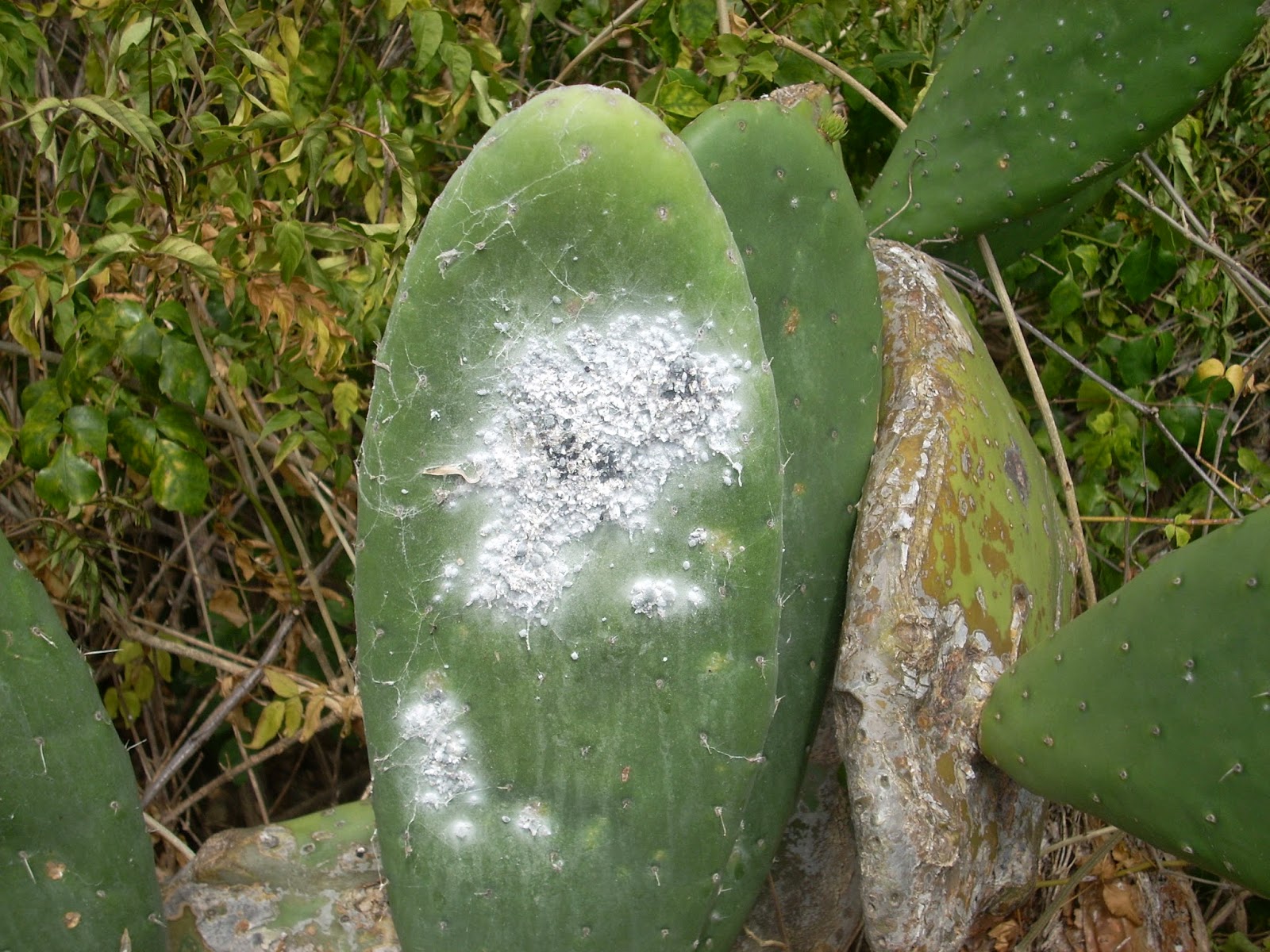
Travellers taking a close look at a prickly pear plant, especially on the southern hillsides of Tenerife, will often discover not only the reddening and delicious prickly pear fig flowering on the rim of the cactus leaf or paddle, but also a mass of tiny dark-coloured insects under an ashen-white, waxy substance which the nymphs secrete to protect themselves from the sun. 
Cochineal beetles on a cacturs plant (Montaña de la Horca in the Orotava Valley)


It is from the female of this parasite that the carmine dye is taken. The male is grey and has wings. The female is wingless and is a much more impressive dark blue-red colour. Like most living species she does most of the hard work. On the other hand it is the duty of a solitary male to cope with three hundred females for the purpose of reproduction, enabling each female to then lay hundreds of eggs.

Female cochineal beetle (Dactylopius coccus) 

Producing carmine dye from the beetle is not an easy task but during its heyday in the 1860s and 70s tunera farming for the cochineal insect proved very profitable. A thriving cochineal industry in the Canary Islands survived until the 1970s although synthetic dyes had long before made the breeding and harvesting of the cochineal beetle too costly and labour intensive. It required 70,000 beetles to provide a single pound of cochineal dye as well a lot of women wearing layers of clothing as protection against the cactus thorns in order to gather in the beetles.

Olivia Stone, nineteenth century traveller and author of Tenerife and Its Six Satellites, explored the Canary Islands with her husband, John Harris Stone in the 1880s. She described women scraping the insects into large flat metal trays. This procedure occurred when females of second generation of beetles were ready to lay their eggs. The trays of insects would then be placed in ovens to toast. The beetles could also be put into boiling water and later dried in the sun. She also described insects being mixing together with black sand in a linen bag several feet long which would then be swung back and forth by men holding each end of the bag until the juices seeped out. In the industry’s halcyon days, as Olivia Stone described them, before the discovery of synthetic dyes, cactus farmers could make between 75 and 100lbs from an acre of ground. It was a very profitable business and labour in those days was extremely cheap.

Olivia Stone

The Spaniards discovered cochineal in the 16th century during their South American conquests, particularly in Mexico. The Aztec people were using it to dye their blankets and clothes but also squeezed the beetle with their fingers and rubbed the resulting scarlet juice or blood onto their faces as war paint. Historians suggest the amazing Aztecs had been cultivating the beetle since the 10th century. 


Indian collecting cochineal (image taken from Wikipedia)

Most inhabitants had cactus growing in their fields and were very careful to protect the beetles from rainstorms. However they never realised the economic significance of their precious insects until the Spaniards began to harvest them and cochineal became one of the colonies’ principal exports.


A cluster of cochineal insects under their protective white powder

The resultant red dye after having squeezed the insects

By the 17th century the colouring of fabrics had become one of Europe’s most important industries and cochineal dye, imported from Mexico, Peru, Bolivia and Chile accounted for a fifth of the Royal income during the reign of Philip II. The king is thought to have described cochineal as a commodity equal to gold and silver. The Spaniards were able to maintain secret their discovery and the process involved in producing the dye for many years. They considered the cochineal dye industry so important to their own economic interests that they encouraged a lack of knowledge and even the use of deceit to hide the secrets of the tiny prickly pear beetle.

Philip II of Spain in a painting by Antonio Moro

However, French botanist Nicolas-Joseph Thiéry de Menonville discovered the Spanish mystery in 1777. He smuggled some insects out of New Spain and attempted to cultivate cochineal in Haiti with scant success. The climate was too humid. The French also planted cactus in Madagascar and Algeria. The plant flourished but the beetle did not survive the climatic conditions and their experiments failed.

Even the Spaniards found no success in their early attempts to bring the industry across the Atlantic to Europe and they could not compete with their American colonies. However, just before Mexico became independent in 1836, the cochineal beetle was introduced to the Canaries where the Opuntia variety of cactus for the production of the prickly pear fruit, the higo pico, was already a success. 


Girl collecting prickly pears - painted by wonderful Canary Island artist Celestino Mesa


Prickly pears

The climate and temperature was perfect. Production spread rapidly throughout the islands despite initial fears amongst landowners that the industry would damage their traditional vineyards. Nevertheless, when they realised the high profits they could make from the beetles they took a very keen interest. At the same time South American countries began to favour coffee production on a large scale. This led to the cochineal industry in the Canary Islands becoming even more important. In fact such was the monopoly that landowners were able to set their own high prices.

The Canaries flourished for many years on the cochineal industry. It replaced many of the islands’ famous vineyards which had been so cruelly devastated by the oidium tuckeri, the powdery mildew fungus which thrives in the mild, humid conditions found in the northern valleys of Tenerife and other mountainous islands. British Consular reports reveal that cochineal even replaced wine as the Canary Islands’ main exportable product to British seaports. In fact cochineal dye from the Canary Islands also played a significant role in the development of the English textile industry during the industrial revolution. 

There is little doubt that English orders for cochineal helped turn many of the rugged volcanic malpaís badlands into productive cactus plant enclaves. In 1831 the amount of dye powder bought by textile merchants in England was a tiny 8lbs. Ten years later exports had risen to over 100,000lbs. In 1850, the wine trade having been virtually wiped out by disease, cochineal dye exports to Britain were an estimated 783,000lbs. By 1861 the figure had risen to over 2,000,000lbs. But there was yet more to come. Production of the dye and its exports to Britain reached a peak in 1869 with over 6,000,000lbs. One of the principal clients for cochineal dye was the British Government. 

The charge of the Royal Scots Greys at Waterloo - painting by Robert Alexander Hillingford

Originally only for officers' uniforms, cochineal became the vital ingredient in conjunction with certain chemicals which was used to produce the brilliant scarlet of the famous British Army tunics, so fearlessly worn in battle but which made such easy targets for the enemy. 

(Some images have been reproduced from internet with no personal financial gain intended.)


By John Reid Young
Author of The Skipping Verger and Other Tales


http://www.expat-blog.com/logo/expatBlogSmall.gif