Tuesday, July 1, 2014

Had Charles Darwin landed on the island of Tenerife


Just over a century and a half ago, in 1859, Charles Darwin published his theory of evolution with compelling evidence in On the Origin of the Species by Natural Selection. His interest in natural evolution had gown as a result of his five year voyage of natural exploration around the world aboard H.M.S. Beagle.

Charles Darwin joined the scientific elite as a young man

What many people living in the Canary Islands don’t know is that he came so close to being yet another of the great scientists who fell for the charms of Tenerife before the island became a victim to the onslaught of progress. According to his autobiography of 1881, Darwin’s interest in the island stems from his days as a young student at Cambridge. Some of his letters refer to his desire to live in Tenerife for a time in order to study the unique nature of the island’s flora. 


Echium Wildprettii, the tower of jewels, the red Tajinaste, Tenerife Burgloss

In fact Darwin longed to visit the island, particularly the Valley of La Orotava, after reading so much about the island in the works of Friedrich Alexander von Humboldt, the famous German naturalist and geographer.

Alexander von Humboldt painted by Friedrich Georg Weitsch in 1806

The young fellow was evidently not a good student in spite of his father, Robert Darwin, being a physician, poet and naturalist. On the contrary, he rather enjoyed his early student days riding, shooting, listening to music and collecting beetles, a popular craze in those days and which he was particularly good at. Putting the pleasures of life before study is not surprising. His father sent him to Cambridge to prepare himself as an Anglican parson because he wouldn’t take his learning seriously at the University of Edinburgh’s Medical School. Preaching the word of God was not his thing. Nevertheless he settled down after making friends with clergyman and Professor of botany and geology, John Stevens Henslow, who persuaded him to study geology. Indeed it was Henslow, in 1831, who secured his position as naturalist aboard H.M.S. Beagle, commissioned to carry out a five-year voyage surveying different parts of the world. 

John Henslow, Darwin's friend and mentor

Charles Darwin was delighted, especially after learning that one of the first ports of call was going to be Tenerife. However, he was to be terribly disappointed a few months later, and one has to wonder if the island and the Orotava Valley would have evolved as they have had Charles Darwin landed in Tenerife. Would he, like today’s beautiful statue of Alexander von Humboldt, which sits above the valley, also turn his back to what paradise has become as a result of human progress?

The beautiful statue of Alexander von Humboldt

The naturalist had planned a thorough exploration of the island with his friend Ramsay. But just as they released anchor off the port of Santa Cruz, a small rowing boat from the island Health Office came out to meet the Beagle. An officer informed Captain Robert Fitzroy that they were prevented from going ashore. News had arrived that there had been an outbreak of cholera in England and therefore, as a precautionary measure, the crew and passengers aboard H.M.S. Beagle would have to wait out a quarantine period of twelve days before setting foot on Tenerife.

H.M.S. Beagle

As Fitzroy recorded, “this was a great disappointment to Mr Darwin, who had cherished a hope of visiting the Peak. To see it, to anchor and be on the point of landing, yet be obliged to turn away without the slightest prospect of beholding Tenerife again, was indeed to him a real calamity”.

Capt. Robert Fitzroy

As Alan Moorhead suggested in his book “Darwin and the Beagle” in 1969, it was also a disappointment for the island’s inhabitants. Local daily newspaper, El Día insisted the island had been denied the visit and investigations of one of the greatest scientists of the time.

On the Beagle was Darwin’s great friend, Auguste Earle, the painter. He had embarked with Charles Darwin in April 1832 as topographical artist and draughtsman aboard the Beagle although problems with his health forced him to leave the ship at Montevideo and return to England. He too was disappointed at being prevented from going ashore in Tenerife. His sketches would sit proudly alongside those of so many fine artists who have captured the charms of the island. 


The Botanical Gardens in the Orotava Valley, in the Marianne North Gallery at Kew

Nevertheless it appears Earle was able to paint what his eyes could see from aboard the ship and it would be interesting to find an example of that particular work. H.M.S. Beagle went on her way before the twelve days of quarantine were up because Captain Fitzroy felt he needed to take advantage of perfect weather conditions for crossing the Atlantic.

  
                                             Euphorbia Canariensis (courtesy of The Marianne North Gallery at Kew Gardens)
           
A Phoenix Dactylifera palm overlooking the old Port Orotava (courtesy of The Marianne North Gallery at Kew Gardens)

 It was many years later that Charles Darwin’s attention was drawn again to Tenerife. Through conversations with other botanists and admirers of Tenerife like Sir Charles Lyell and Marianne North, he was able to sense the gentle and often spectacular and colourful nature of the island which he had so cruelly been deprived of exploring all those years before.Indeed, Marianne North was able to enchant Darwin when he was an old man with her paintings of botanical species in Tenerife.

(Some images have been reproduced from internet with no personal financial gain intended.)

By John Reid Young
Author of The Skipping Verger and Other Tales


http://www.expat-blog.com/logo/expatBlogSmall.gif

Sunday, May 18, 2014

The Canaries, the British Army and Prickly Pears


In most well stocked larders in the early 20th century an inquisitive child might discover a little bottle of crimson essence labelled carmine or cochineal. The cook used it to colour the icing on birthday cakes or for flavouring. It was also used as a natural dye for colouring sweets, medicines and cosmetics because it was neither harmful nor toxic. But originally cochineal was processed as a dye for textiles.

A bottle of cochineal

The cochineal dye was, and still is on a smaller scale, obtained from a sessile parasite which is native to tropical and subtropical South American regions. The insect survives by sucking the juices and nutrients principally from the Opuntia or paddle cactus, a genus in the cactus family which is often referred to as tuna in the Canary Islands.

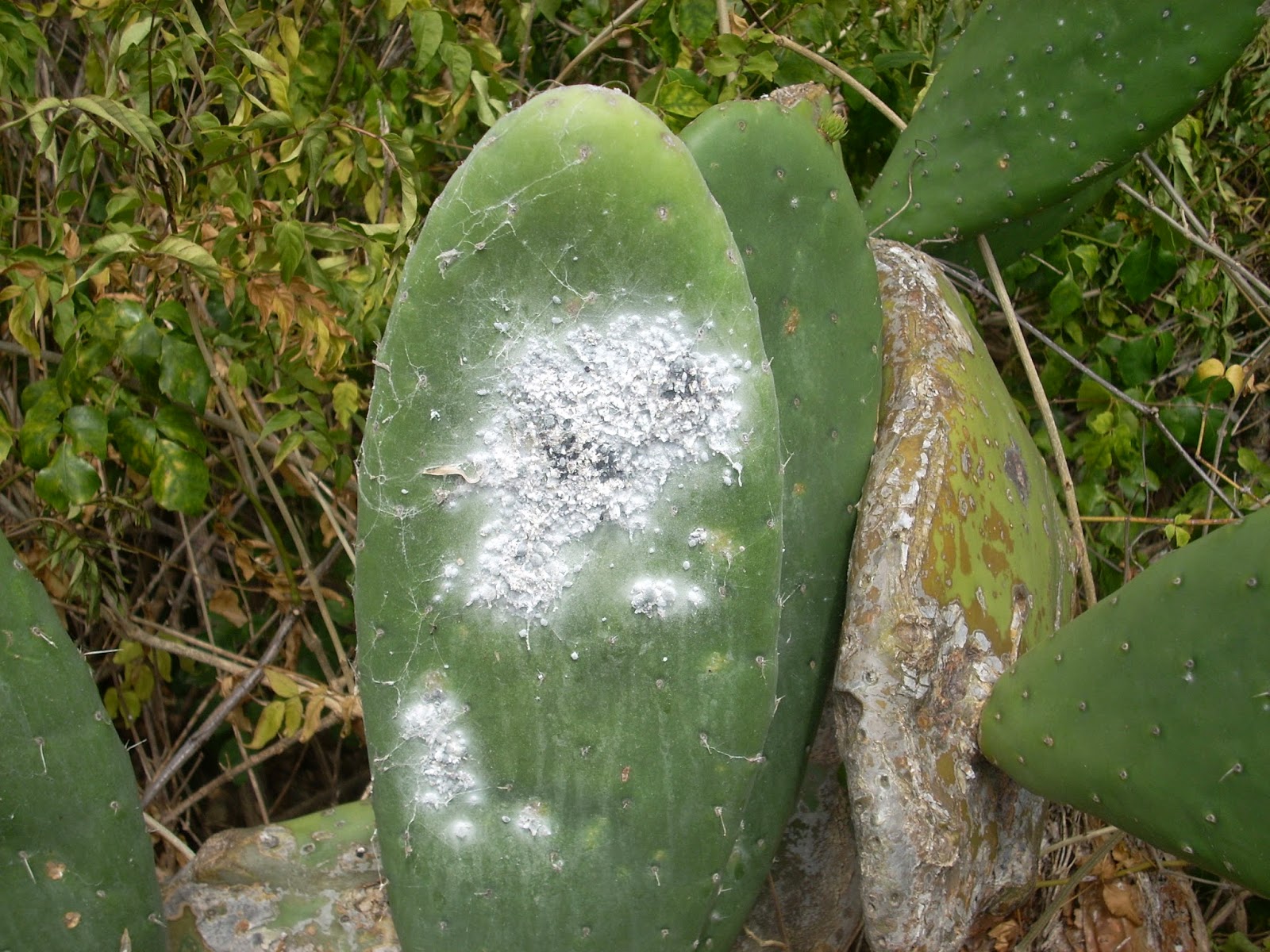
Travellers taking a close look at a prickly pear plant, especially on the southern hillsides of Tenerife, will often discover not only the reddening and delicious prickly pear fig flowering on the rim of the cactus leaf or paddle, but also a mass of tiny dark-coloured insects under an ashen-white, waxy substance which the nymphs secrete to protect themselves from the sun. 
Cochineal beetles on a cacturs plant (Montaña de la Horca in the Orotava Valley)


It is from the female of this parasite that the carmine dye is taken. The male is grey and has wings. The female is wingless and is a much more impressive dark blue-red colour. Like most living species she does most of the hard work. On the other hand it is the duty of a solitary male to cope with three hundred females for the purpose of reproduction, enabling each female to then lay hundreds of eggs.

Female cochineal beetle (Dactylopius coccus) 

Producing carmine dye from the beetle is not an easy task but during its heyday in the 1860s and 70s tunera farming for the cochineal insect proved very profitable. A thriving cochineal industry in the Canary Islands survived until the 1970s although synthetic dyes had long before made the breeding and harvesting of the cochineal beetle too costly and labour intensive. It required 70,000 beetles to provide a single pound of cochineal dye as well a lot of women wearing layers of clothing as protection against the cactus thorns in order to gather in the beetles.

Olivia Stone, nineteenth century traveller and author of Tenerife and Its Six Satellites, explored the Canary Islands with her husband, John Harris Stone in the 1880s. She described women scraping the insects into large flat metal trays. This procedure occurred when females of second generation of beetles were ready to lay their eggs. The trays of insects would then be placed in ovens to toast. The beetles could also be put into boiling water and later dried in the sun. She also described insects being mixing together with black sand in a linen bag several feet long which would then be swung back and forth by men holding each end of the bag until the juices seeped out. In the industry’s halcyon days, as Olivia Stone described them, before the discovery of synthetic dyes, cactus farmers could make between 75 and 100lbs from an acre of ground. It was a very profitable business and labour in those days was extremely cheap.

Olivia Stone

The Spaniards discovered cochineal in the 16th century during their South American conquests, particularly in Mexico. The Aztec people were using it to dye their blankets and clothes but also squeezed the beetle with their fingers and rubbed the resulting scarlet juice or blood onto their faces as war paint. Historians suggest the amazing Aztecs had been cultivating the beetle since the 10th century. 


Indian collecting cochineal (image taken from Wikipedia)

Most inhabitants had cactus growing in their fields and were very careful to protect the beetles from rainstorms. However they never realised the economic significance of their precious insects until the Spaniards began to harvest them and cochineal became one of the colonies’ principal exports.


A cluster of cochineal insects under their protective white powder

The resultant red dye after having squeezed the insects

By the 17th century the colouring of fabrics had become one of Europe’s most important industries and cochineal dye, imported from Mexico, Peru, Bolivia and Chile accounted for a fifth of the Royal income during the reign of Philip II. The king is thought to have described cochineal as a commodity equal to gold and silver. The Spaniards were able to maintain secret their discovery and the process involved in producing the dye for many years. They considered the cochineal dye industry so important to their own economic interests that they encouraged a lack of knowledge and even the use of deceit to hide the secrets of the tiny prickly pear beetle.

Philip II of Spain in a painting by Antonio Moro

However, French botanist Nicolas-Joseph Thiéry de Menonville discovered the Spanish mystery in 1777. He smuggled some insects out of New Spain and attempted to cultivate cochineal in Haiti with scant success. The climate was too humid. The French also planted cactus in Madagascar and Algeria. The plant flourished but the beetle did not survive the climatic conditions and their experiments failed.

Even the Spaniards found no success in their early attempts to bring the industry across the Atlantic to Europe and they could not compete with their American colonies. However, just before Mexico became independent in 1836, the cochineal beetle was introduced to the Canaries where the Opuntia variety of cactus for the production of the prickly pear fruit, the higo pico, was already a success. 


Girl collecting prickly pears - painted by wonderful Canary Island artist Celestino Mesa


Prickly pears

The climate and temperature was perfect. Production spread rapidly throughout the islands despite initial fears amongst landowners that the industry would damage their traditional vineyards. Nevertheless, when they realised the high profits they could make from the beetles they took a very keen interest. At the same time South American countries began to favour coffee production on a large scale. This led to the cochineal industry in the Canary Islands becoming even more important. In fact such was the monopoly that landowners were able to set their own high prices.

The Canaries flourished for many years on the cochineal industry. It replaced many of the islands’ famous vineyards which had been so cruelly devastated by the oidium tuckeri, the powdery mildew fungus which thrives in the mild, humid conditions found in the northern valleys of Tenerife and other mountainous islands. British Consular reports reveal that cochineal even replaced wine as the Canary Islands’ main exportable product to British seaports. In fact cochineal dye from the Canary Islands also played a significant role in the development of the English textile industry during the industrial revolution. 

There is little doubt that English orders for cochineal helped turn many of the rugged volcanic malpaís badlands into productive cactus plant enclaves. In 1831 the amount of dye powder bought by textile merchants in England was a tiny 8lbs. Ten years later exports had risen to over 100,000lbs. In 1850, the wine trade having been virtually wiped out by disease, cochineal dye exports to Britain were an estimated 783,000lbs. By 1861 the figure had risen to over 2,000,000lbs. But there was yet more to come. Production of the dye and its exports to Britain reached a peak in 1869 with over 6,000,000lbs. One of the principal clients for cochineal dye was the British Government. 

The charge of the Royal Scots Greys at Waterloo - painting by Robert Alexander Hillingford

Originally only for officers' uniforms, cochineal became the vital ingredient in conjunction with certain chemicals which was used to produce the brilliant scarlet of the famous British Army tunics, so fearlessly worn in battle but which made such easy targets for the enemy. 

(Some images have been reproduced from internet with no personal financial gain intended.)


By John Reid Young
Author of The Skipping Verger and Other Tales


http://www.expat-blog.com/logo/expatBlogSmall.gif

Monday, March 10, 2014

Jimmy Pills, a Scottish Doctor in Tenerife


     British residents who were lucky enough to have lived in what was still an enchanting Orotava Valley on the Atlantic island of Tenerife in the early 20th century knew him affectionately as Jimmy Pills. He was one of only a handful of doctors attending to a local population of just a few thousand. It was a time when the one or two little hospitals in the valley were in the hands of local ladies’ committees and run by nuns. The sisters, in their white and black habits, acted as nurses and were believed to be quite efficient. However, by tradition, they were not permitted to touch a male invalid.

 The enchanting Orotava Valley, as painted by Ella Du cane

     Doctor Ingram was born in Edinburgh in 1860. His father was the Reverend Gordon Ingram, Minister of Urquhart and he was one of eleven brothers and sisters. When he arrived in Tenerife after a spell in Africa in about 1903 he initially worked with Doctor Tomás Zerolo, a well-known local practitioner based in La Orotava. Eventually he took over a surgery from a fellow Scot, Doctor Frederick Lisham, in Puerto de la Cruz. Jimmy Pills became a very popular figure in the town and was well liked by both British and Canary Islanders. He rented San Antonio, the huge mansion just beside the British Games Club where he lived with his wife, Leticia McAndish.

  The San Antonio mansion, as seen from the bowls green at the British Games Club

     It might have been a personal decision taken by a grumpy councillor at the time but when he first applied to open his own surgery in Puerto, Doctor Ingram was not granted permission to do so for one of those simple, bureaucratic reasons minor politicians so enjoy to find. He couldn’t provide acceptable proof in Spanish that he was a qualified doctor, even though his medical knowledge had already been put to the test with considerable merit under Doctor Zerolo in La Orotava. In other words, he might have been highly trained in Edinburgh but without a Spanish title obtained at a Spanish University there was nothing to do. Like most British residents who decide to settle in the Canary Islands, Jimmy Pills was by no means a linguist and never quite got to grips with the Spanish language, and his accent was often made fun of. Nevertheless James Ingram refused to give up. After studying at Madrid University he got his Spanish title and with it permission to treat local patients.
     In those days privileged folk in the Canaries seem to have suffered quite a lot from rheumatism, gout and diseases of the kidney. Jimmy Pills was always one for healthy, natural remedies and would advocate patients, especially those with gout and kidney complaints, to indulge themselves with a constant supply of green vegetables, tomatoes and fresh fruit, all of which were in abundance locally.

 Abundant local produce at the market

     Nevertheless, he was anxious to advise newly arrived visitors that they should wash fruit and vegetables thoroughly before eating them, to refrain from taking exercise in the heat of the summer and to be extremely wary of the local wine. Canary wines today are first class, of course, the whites and rosés being highly acclaimed for their quality and variety, but unwary foreigners do still suffer bouts of what, in the early 1900s, was known as climatic diarrhoea. This was commonly blamed upon some kind of unsympathetic matter in the stomach and the cure would generally be commenced by a very Anglo-Saxon strong dose of castor oil. Much more pleasant was a retreat, by mule, up into the dry atmosphere on Mount Teide, which apparently did wonders for lung complaints. However, Jimmy Pills was a great believer in sea bathing all the year round, which he strongly recommended to keep bugs at bay. This was something local islanders tended to avoid doing and many, even a century later, still believe one should only step onto the beach from May until October…when the magnificent black sand beaches are almost too hot to walk upon.

English ladies on the Martianez Beach in Puerto de la Cruz in the early 20th century

     James Ingram was a likeable gentleman and he became one of the great characters in the valley. He was driven around the dusty roads in a little Ford by his local chauffeur called Tamajón, and most of the wealthy families were treated by him at one stage or another. The Scottish doctor was also generous with the poor. There was no health service, of course, and he is known to have never asked for a penny from anyone who didn’t have the means to pay. 
     Jimmy Pills took on a young apprentice, Doctor Isidoro Luz Carpenter, and an English nurse called Miss Stevens. The apprentice went on to become one of the finest doctors in the valley and he must have learnt a thing or two from his Scottish mentor because queues of working class patients would be seen waiting for free medical treatment outside the surgery in the middle of banana plantations on his estate, El Llano del Pavo.


A Memorial sculpture of Isidoro Luz on the Matianez seafront in Puerto

     Doctor Luz also became one of the most outstanding mayors ever to govern Puerto de la Cruz and it is perhaps through him that the good Doctor Ingram is still remembered today. As Mayor many years after the doctor’s death in 1933, he was able to honour James Ingram by naming one of Puerto’s central streets after him. In fact Jimmy Pills had already been decorated by the Town Council towards the end of the First World War for his work dealing with a flu epidemic.

                                                                       Doorway to the Protestant Cemetery in Puerto de la Cruz

     James Kyd Duncan Ingram died in 1933 and was laid to rest in el cementerio inglés, the English Protestant Cemetery in Puerto de la Cruz.


By John Reid Young
Author of The Skipping Verger and Other Tales


http://www.expat-blog.com/logo/expatBlogSmall.gif

Tuesday, February 4, 2014

Mr. Brown's little book


     There is little doubt that the Canary Islands owe much of their thriving tourism industry to British travellers, scientists, artists and photographers of the 19th century. Their interesting articles, beautiful watercolours, pioneering photography and illustrated booklets published back in the United Kingdom became the islands’ original promotional instruments.

Front cover of Madeira and the Canary Islands

     But it was Alfred Samler Brown and his traveller’s guidebook Brown’s Madeira, Canary Islands and Azores which possibly did most to begin the flow of enthusiastic and well-prepared holidaymakers. These grey-blue little books very soon became an essential companion for anyone travelling to the islands from the 1890s until the outbreak of the Second World War.

     Although he travelled far and wide, Samler Brown was particularly admired and respected by the local population in the Canaries. He was frequently mentioned in the local press. El Diario de Tenerife recognised not only his work but the gratitude felt by the local authorities for his spreading the good word about the islands. Such was this appreciation that King Alfonso XIII decorated him for exporting knowledge about the islands.

King Alfonso XIII was only 20 years old when he visited Puerto de la Cruz in1906

     Alfred Samler Brown’s guidebooks were much more than just a simple handbook for travellers. He spent long periods on the islands and was extremely methodical and precise, going into fine detail about culture, traditions and history. He was also entirely reliable with information about distances, prices, population, accommodation and even meteorological statistics. In Brown’s Madeira, Canary Islands and Azores travellers could find all sorts of interesting and valuable information and the book received excellent reviews in publications like The Field.

     In 1932 The British Medical Journal, which had already quoted so many British doctors and scientists acclaiming the Canary Islands as a health resort, his little book was described as one of the most scientific and accurate guidebooks ever written, full of facts and free from embroidery. For example, he recorded that between 1890 and 1897 rain fell in Puerto de la Cruz for an average of 6.8 days during February and 59.6 days during the whole year. He might sympathise with all those winter visitors to Tenerife who have found the beginning of 2014 so unusually wet and English.

     As far as the Canary Islands were concerned Alfred Samler Brown was evidently most fond of Tenerife and distinguished the island above Grand Canary, calling it, by virtue of its height, the meteorological centre of this part of the world.  However, understanding the eternal rivalry that existed between the political inhabitants of the two islands, both believing they were naturally superior to the other, the author pointed out that his observations were purely scientific.

     Santa Cruz from the sea - note the snow-covered mountains in the background
Image courtesy of Fotografía Alemana

     Samler Brown was one of a very few British travellers to have actually been pleasant about the capital, Santa Cruz, which he described as a picturesque and pleasant town, filled with beautiful balconies, fresh patios and curious corners. In fact he lived with his wife Helen on quite a large property which he bought close to the fishing village of San Andrés. 

Calle La Marina, Santa Cruz in 1913

     Nevertheless, like most early travellers who arrived on the island of Tenerife long before the southern beach resorts were opened to mass tourism, he highly recommended a stay in Port Orotava, today known as Puerto de la Cruz. His guidebook described the town as probably the best-known health resort in the world. Samler Brown never hid the fact that he had originally come to the islands to improve his own ill health and always said he owed his recovery to his first sojourn in the Orotava Valley. Puerto, he said, was a rather pretty place, especially around the mole, where colourful fishing boats and groups of old houses and balconies offer some capital opportunities to the artist. Indeed many old local houses boast paintings of scenes in Puerto de la Cruz signed by British travellers and artists such as Ella Du Cane in the early part of the 20th century.

A street in Puerto Orotava - Ella Du Cane

     In those long ago days the speed at which one went about one’s business did not have the ghastly stress-productive importance it has today. The day was spent in a rather leisurely manner. Consequently people were very easy going and had plenty of time to be polite and generous. Permission would always be granted to anyone wishing to paint a scene from the privacy of someone’s balcony.

     Samler Brown was a pioneer in terms of travel books, being one of the first to introduce advertisements into his guidebook. A number of pages were taken up by steamship companies such as the Blue Funel Line which sailed from Glasgow and London to South Africa and Australia, the Yeoward Line which offered cruises to the Canaries on their fruit and banana boats to and from Liverpool or the Royal Mail Steam Packet Company providing health and pleasure cruises via Morocco and the Canaries as far as New York, Uruguay or Argentina.

Cruises to Morocco, the Canaries and Madeira took a leisurely 23 days

     His guidebooks were also filled with advertisements from other nationalities and they were sold not only in Britain but in Paris, New York, Berlin, Nice and even Cape Town. Local companies in Tenerife, like Thomas M. Reid and Company in Port Orotava advertised themselves as bankers and general merchants, while hotels like the Victoria in La Orotava or the Monopol in the port took whole pages advertising their particular qualities. 

Reid's failed to keep with the times and succumbed after 100 years of enterprise and service

     The Monopol, for example, called itself a first class family hotel and the only one in the valley with hot and cold water laid on to bedrooms. Luckily it still flourishes today as a reminder of how charming the old Puerto de la Cruz was and still is.

Puerto today, still picturesque and charming

     By the time he died in 1935 his guidebook had reached its 14th edition. It was that essential companion for the intrepid traveller of the era but it had also found a corner on the shelves of most private libraries in the Canary Islands. Alfed Samler Brown became a distinguished and welcome citizen whose gentle humour found its way into the hearts of all who had the pleasure of knowing him. Perhaps he would still smile at the thought that on 21st February, 1905 he became the first person to ask the Civil Governor of Tenerife for permission to drive his own automobile. It was the first of many of Coventry’s Humbers to be imported to Tenerife and carried the number plate TF3.

By John Reid Young
Author of The Skipping Verger and Other Tales


http://www.expat-blog.com/logo/expatBlogSmall.gif

Friday, January 10, 2014

Mount Teide.....just an afternoon's stroll in the Canary Islands.

     The Orotava Valley, on the island of Tenerife, awakened to a sunny day late in February 1963. It was a relief after such heavy rains and Mount Teide sparkled invitingly high above, showing off its finest costume. Business carried on as usual in the gentle and picturesque town of Puerto de la Cruz.


Puerto de la Cruz in the early 1960s

     However, there appeared to be a commotion that Tuesday morning at the Honorary British Vice-Consul’s office. A rather distressed, middle-aged English lady and a good looking young gentleman appeared to be having a heated discussion. They were led across the Spanish courtyard and up the magnificent wooden staircase to the first floor of what was known as La Casa Reid. That was where Noel Reid shared offices with his brother Rio.

     When Mr. Reid returned home late for lunch he explained to his wife that he had had a busy morning dealing with the case of a fellow Scotsman who appeared to have got lost on Mount Teide.

     The lady and her husband, Dr. Graham McPhee arrived at the Las Vegas Hotel in Puerto on Friday, 22nd February for a fortnight’s holiday. She recalled that as their aeroplane descended over Tenerife her husband spotted Mount Teide covered in a heavy blanket of snow and exclaimed, “I must climb that mountain!” She protested. He had promised to take her away to a warmer climate in order to recover from illness and she was so tired of mountains. “It’s just an afternoon’s stroll”, he replied. After all, George Graham McPhee was a well-known and accomplished mountaineer and he would be back in time for tea. 


Mount Teide from the air

     Born and educated in Glasgow, he joined the Highland Light Infantry at the age of seventeen. He transferred to the Royal Flying Corps and was a pilot over France before being shot down and made prisoner in 1917. After the war he graduated at Glasgow University before finishing his medical studies in Vienna. But his heart was in challenging mountains and by the time he married Jean Craigie in 1930 this most attractive personality had climbed every peak in the United Kingdom. As his friend, Iain Ogilvie remarked in his obituary, “he possessed an incorrigible sense of fun and was at times outrageous”. In fact his application to join the Alpine Club in 1934 would have failed had it been known that he had climbed the south face of the Aiguille Noir de Peuterée unaccompanied. He made eleven first ascents in the Swiss Alps in 1935 and climbed the same eleven 4,000m peaks, crossed the Zermatt mountains and spent seventeen hours on Le Dent d’Hérens when he was sixty. After returning to the climbers’ hut his colleagues were ready for bed, but he preferred the comfort of a hot bath and continued on his own in the blizzard to their hotel nine miles down the valley. After that feat, in a speech by a fellow mountaineer at a meeting of the Alpine Club, he was referred to as a remarkable old gentleman. He replied, rather angered by the description, "I am neither remarkable nor old!".


Le Dent d'Hérens in the Swiss Alps

     There was no stopping this remarkable old gentleman.......except, it appears, his afternoon stroll on Tenerife’s peak. News of his death even reached Australia during the visit of Queen Elizabeth and the Duke of Edinburgh and on 4th March the Sidney Morning Herald reported “the body of Dr. George Graham McPhee, of Heversham, Westmorland, was found on Teide Mountain. Lady Hunt, wife of mountaineer Sir John Hunt, made five lone ascents on the snow-covered mountain to search for her friend before hikers found his body”. In fact the hikers were local Canary Island guides. Lady Joy Hunt, who was accompanying the McPhees on the island holiday, had learnt to climb in the Himalayas with her husband, Sir John, of Everest fame.


Sir Edmund Hillary, Sir John Hunt and Tenzing Norgay

     As far as an old diary can tell, the first thing Dr. McPhee did the day after arriving at the hotel in Puerto de la Cruz was to ask at the reception desk about the possibility of climbing Mount Teide. He was inspected as if he were quite mad. Nobody climbed the volcano at this time of year! It was the closed season. It was far too dangerous. Besides, the three young men who acted as guides for adventurous British visitors were not usually available at least until April.


The Las Vegas Hotel in 1963

     A young Italian tour representative overheard the conversation at the Las Vegas and intervened. He claimed to be an expert guide and said it would be a pleasure to take the sixty five year old Briton up the mountain. Another young English couple also joined the conversation at the reception desk and it was agreed the Italian would take them all up in to the mountains early the following morning in his own car. In their report to the British and Spanish authorities the Italian and the young English couple said they drove as far as the old Guardia Civil outpost which used to be close to the foot of the magnificent volcano. It was a beautiful Sunday morning, the snow sparkling in the warm sunshine, and they set off in spite of the guardias warning that it would be unwise to climb Teide because the sun and the wind had turned the snow into ice. Indeed, the English couple soon realised the climb was too much for them and suggested they all return to base. McPhee is said to have replied “If I make up my mind to do something I don’t give up when I meet difficulties”. The Italian guide also began to feel that he might have made a terrible mistake and tried to persuade the Briton to turn back. But the mountaineer was determined and the Italian was honourable enough to keep his word. So, while the other two returned to the car McPhee and his guide went on. 
     
     When I was a twelve year old boy, before the cable car was installed to ferry visitors up the slopes of Mount Teide, I was invited to climb the volcano by a group of medical students from the University of La Laguna. They treated me like some kind of lucky mascot and I was given a piggyback ride on the last stretch when sulphurous fumes made me sick. It was midsummer, there was no snow and we set off in the early evening to avoid the worst of the day’s heat and to capture the spectacular sight of Teide's shadow at sunrise. 


At dawn, on Teide's summit, looking at its own shadow as the sun rises.

     It was not a difficult climb for a fit person following the mule track to the Altavista refuge station three quarters of the way up, but the climb still took four hours. The original refuge, just a simple, volcanic stone wall to keep his instruments out of the wind, was erected by British astronomer Charles Piazzi Smyth. He spent sixty five days on Mount Teide in 1856.


    Another Englishman, George Graham-Toler, contracted the same builder who built the Anglican All Saints Church in Puerto de la Cruz to erect Altavista, providing proper habitable quarters in the 1890s. His idea was to offer climbers a place to rest and get used to the height, but he also charged a small sum to intrepid British visitors who wished to shelter for the night on the volcano with their mules.


Graham-Toler's Altavista

     Dr. McPhee’s Italian guide described how they had gone to the refuge, not to rest but to leave their backpacks before tackling the summit. He insisted they had reached the top, where they took photographs inside the crater and of the spectacular view below them before starting their descent down the icy surface. McPhee began to complain of cramp in his legs and told the Italian to go down to Altavista ahead of him in order to retrieve their belongings. “I will follow you down and meet you at the bottom”, he told the young guide. When the Italian returned to the mule track he could not see the old climber coming down behind him and assumed he must have already gone down ahead. But when he reached the car he only found the young English couple waiting. They went to ask the Guardia Civil. No, the man they had warned against climbing the peak had not been. The group drove to the recently opened National Parador hotel further down in the island’s sunken Cañadas landcape where they waited until after dark. Eventually Jean McPhee asked to be taken back to Puerto de la Cruz. She was concerned, but quite accustomed to her husband altering course at the last minute if he met an interesting challenge high up on a mountain. It must have been a very sleepless night for the young Italian, however and he returned to climb the volcano again early the following morning in freezing conditions. He called and shouted all the way up and down, but there was no sign of McPhee.


Dr. George Graham McPhee, a very determined character.
(in a photograph from The Scottish Mountaineering Club)

     It was only on the Tuesday morning that Mrs. McPhee decided to seek help at the Reids’ office and an immediate rescue operation was ordered. A spotter plane carried out continuous passes over the snow-covered slopes. The Guardia Civil searched the mountain day and night. They were joined by three local mountain guides and Lady Hunt who spent the next four and a half days combing Mount Teide. Even seventy one year old Noel Reid joined in. But it was futile and nobody will ever know if McPhee might have survived had his disappearance been reported immediately. He was an accomplished mountaineer, but not equipped on this occasion, wearing only plimsolls, for survival on the frozen slopes of a volcano at the height of 12,000 feet.

 
La Casa Reid in the 1960s

     The body was discovered a long way from the mule track he should have been following. It is thought he lost his footing while taking a photograph and slid for some considerable distance down the icy slopes. George Graham McPhee was buried in what was locally known as la cherche, or today as el cementerio inglés, the English cemetery in Puerto de la Cruz.

     The Guardia Civil confiscated the unfortunate Italian guide’s camera during their investigations. It seemed rather a cruel thing to do but to begin with Jean McPhee seemed reluctant to believe his account. Nevertheless, when his film and that in McPhee’s own camera were developed the photographs confirmed that both men had reached the summit. The Italian had been telling the truth. Perhaps they should have planted the Union Jack and il Tricolore on the rim of the crater.

The rim of Teide's crater

     The expected news was broken to Mrs. McPhee at the Reid’s house, in the company of Mr. Fox, the British Consul in Santa Cruz and Reverend Evans-Gregory, the chaplain at All Saints Church in Puerto. Jean McPhee returned to England almost immediately. In the old diary, Noel Reid’s wife, Annette, who had spent time trying to comfort and encourage her almost every day, noted “Mrs. McPhee gave me the impression of being strong, brave and patient.”

     Later in the year Noel Reid received a package from Lady Hunt. It contained three woollen pullovers and three mountaineering ice picks. He was to hand them over to the three local mountain guides who had helped search for Dr. McPhee. Lady Hunt had been very impressed by the dedication, not only of the Guardia Civil police officers but also of the three local mountain guides. They had climbed the freezing Mount Teide for four days without any anoraks or warm clothing and wore only the local lona footwear, made from sacking material and rubber soles.

     McPhee, the expert British mountaineer, was not the first and he will not be the last victim to belittle Mount Teide, the dormant pride of Tenerife and the Canary Islands. 

By John Reid Young
Author of The Skipping Verger and Other Tales


http://www.expat-blog.com/logo/expatBlogSmall.gif